Introduction
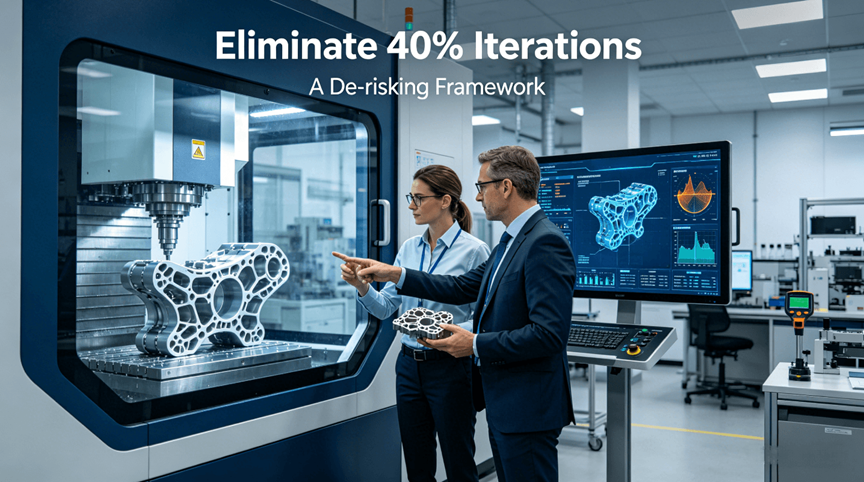
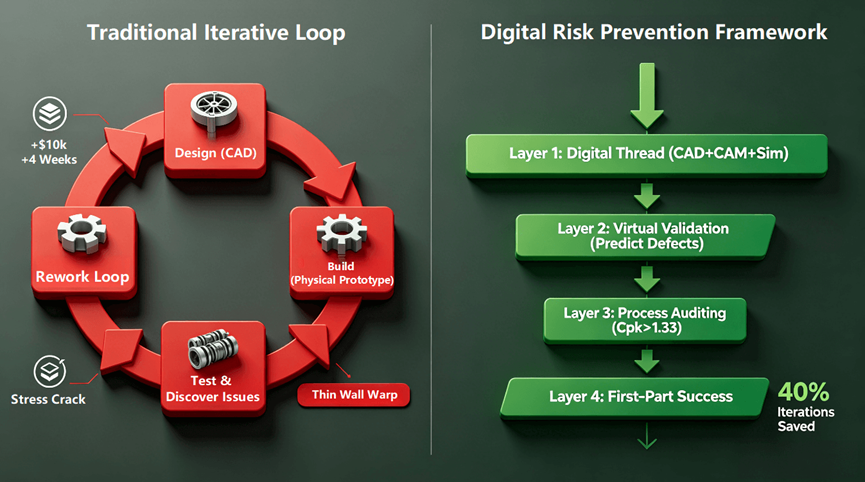
Designing highly complex products such as aerospace actuator housings or medical implant molds inevitably results in being stuck in an expensive “prototype iteration loop,” where each cycle takes months and cost thousands of dollars, thus compromising time-to-market. Research shows that about 40 percent of these prototype iterations occur due to unexpected manufacturing issues rather than core product design issues. These issues include such problems as thin wall deformation, stress induced distortion, and inaccurate dynamics.
All that because of an outdated linear process approach known as “design, toss, build.” The problem is that the digital design does not incorporate any manufacturability considerations while the selection of a potential supplier relies merely on equipment list and fixed quote without any evaluation of advanced engineering capabilities. This paper describes a new approach that incorporates manufacturability studies, supplier technical auditing, and prototype processes verification. With this approach, manufacturing risks may be addressed early enough to avoid 40 percent of prototype iterations.
How Does One Really Calculate the “True Cost” of a 5-Axis CNC Part, Other Than the Machine Hour Rate?
The actual cost of producing a highly complex 5-axis CNC part is much more than just its machine hour rate. The actual cost includes added costs for the geometry’s complexity, additional costs from material handling, and any other costs that may arise during production, along with the engineering assistance required for the process to be done right the first time around.
- The Myth of the “Hourly Rate”: An evaluation of suppliers based on hourly rates is a classic mistake in manufacturing complex parts. The problem here is that there are large disparities in the way each supplier uses those same hours. For instance, an experienced supplier might use a high-end machine with sophisticated thermal management, optimize a tool path that has been tested before, and manufacture the component in one setting. In contrast, a lower-cost supplier will likely need several settings, trial-and-error methods, and longer production times on less efficient machinery.
- The Engineering Premium: Buying Insurance Against Uncertainty: Complex geometries such as deep pockets, high and skinny walls, or organic surfaces require expert engineering to ensure the job can be done. This involves engineering new fixtures, qualifying work holding solutions, engineering collision-free multi-axis toolpaths, and programming probing routines to enable real-time adaptive machining. This initial engineering expense is risk management insurance that addresses and mitigates the fundamental risks that lead to these expensive 40% rework loops. The result is a successful prototype that will return valid information back to the design team.
- Analyzing a Quote to Make Informed Decisions: A professional quote for an intricate component must be an educational piece of literature. The cost breakdown should be clear about the material, software licensing, machine hours, unique fixtures/tools, and testing. Even more importantly, it should specify which elements of the design account for the costs and the reasons behind them. Such transparency helps in making value-based decisions. For a thorough analysis of how to dissect a quote and measure the capabilities of the supplier, a detailed resource on 5-axis CNC parts manufacturing is provided.
How Might Digital Threads Turn Prototyping From Trial & Error Into Predictive Engineering?
A fully digitized workflow will allow one to create a digital thread that links the design intentions with the manufacturing outcome in a predictive way. In doing so, it turns prototyping from a trial-and-error process based on physical prototyping into an engineering process that relies on simulation. The ability to maintain semantic connections between a CAD model and CAM toolpaths is essential here.
From CAD to CAM: Integrating Manufacturing Intelligence from the Beginning
The digital thread starts with the CAD model. With sophisticated software, manufacturers are able to conduct automatic manufacturability analysis and flag any risky elements such as unrealistic aspect ratios or hidden internal geometry, right as the part is being designed. By doing so, changes can be made without any cost and at minimal time investment on an intangible level, rather than having these problems come to light down the road during manufacturing.
Virtual Validation: Validating the Process Virtually before Making Any Cuts
After the design process is completed, the digital thread continues through CAM and simulation. Modern software is capable not only of calculating tool paths but also of simulating the entire process of material removal and tooling deflections, cutting forces, and any other potential collisions. Through virtual validation, engineers can test various approaches to manufacturing and optimize parameters for maximizing tool life and minimizing surface defects. With this method, the first real production run is merely the verification of an already thoroughly tested digital design.
The Digital Thread as a Collaborative Resource and Repository of Knowledge
Perhaps, the main advantage of the digital thread technology lies in its role as an information repository. Each simulation performed, each tool path calculated, and each optimal parameter obtained constitutes an asset that can be stored in a computer database and easily shared with a manufacturing company for seamless translation of all intentions into reality. As emphasized by the Society of Manufacturing Engineers (SME), integration of digital threads and collaboration capabilities allow companies to accelerate innovation.
Which Metrics Extend Beyond Machine Specifications to Evaluate the Supplier’s Dynamic Process Control?
When evaluating the supplier, you should focus on their living process, rather than merely their machine inventory. Metrics will be demonstrated through thermal compensation records, modular fixtures’ accuracy records, and SPC data for key dimensions. The presence of an ISO-certification such as AS9100D indicates a proactive approach to quality management through a data-centric approach – which is critical in dealing with the complexities of 5-axis manufacturing.
- Evaluating the Dynamic Accuracy and Stability: While the static positioning accuracy of a machine does not mean anything if it shifts based on temperature, the audit process itself should cover the supplier’s process capability in dynamic processes. Ask about their method of dealing with thermal changes in the environment. Inquire if their thermal compensation is fixed by the factory settings or continuously monitored and adjusted. Ask them for test results from regularly conducted dynamic contouring tests such as NAS 979.
- Evaluating Tooling, Fixtures, and Process Disciplines: The machine itself is just a component of the system. Analyze their method in terms of difficult work holding. Are they using modular, engineered fixture systems with documented capabilities and consistency? What about their tooling and measuring practices? Are they well-organized and carefully recorded? Additionally, evaluate an SPC chart for an important dimension on a previous manufacturing job. A Cpk greater than 1.33 is a reliable quantifier of capability and process stability – the exact opposite of the variance that makes prototypes fail.
- The Proven Systems of Industry Certifications: Industries such as aerospace, whose certifications include AS9100D, require companies to implement robust, preventative processes such as APQP and PPAP. While it’s tempting to simply request the certifications at audit time, also ask to view a redacted version of their PPAP process for a complex part similar to your own. In doing so, you will learn how they systematically reduce risk through design reviews and process validation – exactly what it takes to answer the question of how to select a 5-axis CNC supplier for a critical prototype job.
Can a Supplier be a Technical Co-Pilot? Understanding Problem-Solving Capability Through Case Studies
The ideal supplier functions as a technical co-pilot, actively participating in solving problems. This can be best understood by analyzing extreme cases, such as machining a carbon fiber composite wafer handler with a tight tolerance of 0.01mm for flatness, along with how they engineer the problem into a solution. They employ an entire process, from material science research to adaptive machining, indicating that they have developed a systematic means of managing risk, rather than simply having machining capability.
Case Study as a Capability Blueprint
A case study worth sharing needs to be an engineering story. It must describe the technical challenge (e.g., avoiding delamination in the CFRP, maintaining hole patterns at a micron level), conduct an investigation for the root cause of the problem, and then proceed to present the engineering process that was used to solve it. The process may involve material characterization in order to determine its machinability, design of unique PCD tooling, creation of a stress-free fixture, and finally, a sequential adaptive machining procedure with on-the-fly inspection.
Distinguishing Between Process Execution and Innovation
Any shop will execute an established process. A co-pilot innovates without any established process. In the case study, there will be indications of experimental method. Were they machining and testing coupons before? Were they making incremental changes using measured data (cutting forces, vibrations, etc.)? The capability to establish a deterministic process in a new application is what you would expect from a partner who is able to mitigate the technical risks associated with your most challenging prototypes to ensure first-pass success for mission-critical parts.
The Ultimate Value: Transition from a Vendor to a Risk Mitigation Partner
In such a scenario, the collaboration itself becomes completely redefined. You have found yourself a risk sharing partner that shares the burden of technical risk mitigation. And this comes from their significant technical contribution to your project that helps eliminate its biggest risk factor – the technical risk. That is the main reason why projects fail or get delayed. And that is the main reason why you must choose a 5-axis CNC machining services vendor that collaborates on this level of engineering.
How Should the Prototype Phase Be Designed to Provide a Smooth Transition to Volume Production?
The prototype phase needs to be designed in such a way that it becomes the basis of production. It includes adopting the “prototyping for production” approach, where the critical production process, which encompasses machining process, fixture, and inspection process, needs to be frozen and verified. The objective of the prototype phase is to provide a “manufacturing process data package,” ensuring the performance and quality can be replicated through production. Therefore, the transition to volume production becomes smooth and risk-free.
Strategic Prototyping: Qualification of the Manufacturing Process Flow
The objective of this prototype run is no longer “to make the part,” but “to qualify the manufacturing process flow.” In choosing the supplier for the prototype, they need to run the actual manufacturing process flow using the identical or near-identical fixtures, tooling, and operations as intended for manufacturing quantities. This way, one is ensured that the process is capable of meeting all the specifications required. Problems encountered are process-related and can be fixed in one shot, as opposed to being concealed process problems during production launch.
Delivery of the Digital Twin: The Prototype Data Package
In order to be able to extract the most value from your prototype process, you need data. Your ideal partner provides a thorough data package that contains the frozen and optimized CNC program, the setup sheets, and the qualified inspection report with CMM data in addition to information on all critical process parameters (feed rates, spindle speeds, tools). These become the only reference points that will ensure the performance, tolerances, and surface quality of your production parts matches that of the prototyped parts.
Knowledge Transfer and Launch Preparation
Knowledge continuity is essential for a seamless transition. It is vital that the team behind the development of your prototype process remains deeply engaged in the launch process. That way, the tacit knowledge of the process — the reasons behind every single machining step — will not be lost. In addition, the partner needs a concrete plan that supports production scalability by verifying capacity and implementing statistical controls in production. This end-to-forward thinking makes the development of a prototype process an investment that pays off during the custom production stage.
Conclusion
When it comes to the design-to-product transition in competitive markets, the secret is not finding the cheapest supplier for the job, but one that is technically adept. With the systematic approach based on total cost analysis, digital thread integration, dynamic process auditing, and collaboration in problem-solving, teams have all the tools necessary to revolutionize the manufacturing process. Instead of being the leading cause of project risks, manufacturing will become a controllable driver of competitiveness. Saving 40% of the prototypes is no longer an issue of time and money, but of accelerated innovation.
FAQs
Q: We are a startup working on the first prototype of our complicated product. How do we balance costs with required learning?
A: Concentrate on “learning what matters.” Select a supplier whose quotation includes DFM analysis and pay for it rather than for cheaper manufacturing. If this is still too expensive for you, go for “phased prototype,” which is a simpler model used to assess your manufacturing strategy and supplier capacity in advance.
Q: How can we effectively test the validity of thermal compensation claims and 5-axis dynamic accuracy by a prospective supplier?
A: We need documentation, not brochures. Ask them to provide the latest 5-axis dynamic accuracy test (such as NAS 979 contouring test). Ask about thermal compensation and whether they monitor it. The best possible evidence is the report on a first article inspection of similar parts which demonstrates that the part’s features were machined consistently at various points in the cycle.
Q: Our company uses an entirely proprietary material. What should we consider while searching for a suitable machining service provider?
A: We should search for a supplier that has a methodology for material science research. Such a method will be evident from their possession of a test lab or collaboration with a testing organization, database of machining parameters used on previous similar materials, and procedures for running test coupons and optimizing parameters.
Q: What is the key factor in the transfer of information from prototype to production?
A: “Why” the “what.” Not just CAD/CAM files. The rationale for using a particular path to reduce chatter or the order required to reduce residual stress. Make sure that the rationale behind your prototype design decisions is documented in a manufacturing process plan and that you involve your prototype provider in your production launch.
Q: What measures are necessary to protect IP while providing detailed design information for DFM studies?
A: A comprehensive IP policy will have many layers: a comprehensive mutual NDA must be in place. Collaborate only with companies which demonstrate enterprise-level security — secured file portals, secured internal computer networks, and confidentiality training of employees. For highly sensitive cases, consider “black box” production processes. Aerospace / Medical suppliers routinely deal with proprietary IP.
Author Bio
The author is an experienced engineer with more than 15 years of valuable expertise in managing risks that may arise during the production of highly sophisticated and critical parts. The author’s organization, LS Manufacturing, specializes in transforming manufacturing by turning processes that may create uncertainties for any project into a competitive edge. If your current concern is the manufacturing of intricate 5-axis parts and you are interested in getting a risk assessment for your project free of charge, please get in touch with the team for a technical review.