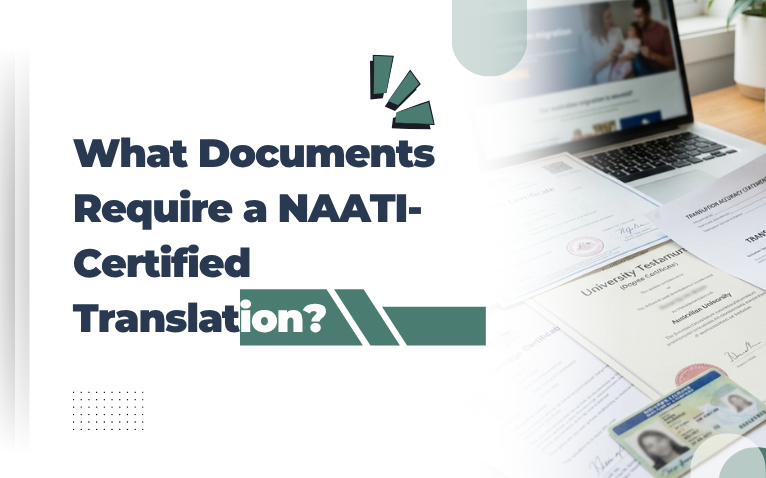
The process of immigrating to Australia or even interacting with the Australian government agencies is full of paperwork. And when the documents are in a different language, you cannot simply give them as they are.
You require a NAATI-approved translation. But what does that really mean? And which documents need it?
This guide answers both questions in plain, simple language.
What Is NAATI?
NAATI stands for the National Accreditation Authority for Translators and Interpreters. It is the government agency that certifies translators and interpreters in Australia.
A NAATI Translator will stamp and sign your document when they are translating it. This informs the Australian authorities that the translation is correct and reliable.
Most of the government departments and migration agents will not accept your documents without this certification, which is why you need proper translations.
Why Does Australia Require NAATI Certified Translation?
Australia receives thousands of visa and immigration applications every year. The government needs to verify information quickly and accurately.
A NAATI translation certification ensures:
- Accuracy– The translator has proven their skills through official testing
- Responsibility– The translator signs the translation with his/her name and credentials.
- Consistency– All translations are in a standard format, which is accepted by the officials.
- Legal validity– The document is accepted by courts, tribunals, and government bodies.
In short, NAATI certification will establish trust between you and Australian authorities.
Documents That Need NAATI-Certified Translation
These are documents that should be translated by a NAATI translator or certified Translation services.
The list is not as short as most people would think. The following are the key categories.
1. Identity Documents
These are the most commonly translated documents. You will need a NAATI-certified translation for:
- Passport- Every page that contains personal information and travel history.
- Birth certificate- Visa applications and citizenship require a birth certificate.
- National identity card – In case it is your main ID.
- Driver’s licence- Required when obtaining an Australian licence.
2. Marriage and Family Documents
Partner and family visa applications require that you demonstrate your relationship and family status.
- Marriage certificate – This is necessary when applying for a spouse and partner visa.
- Divorce certificate – You will have to provide one in case you or your partner has been married before.
- Adoption papers- Needed for child visa applications
- Death certificate – Sometimes used in dependent or compassionate visa applications.
- Name change deed – In case your name was changed.
3. Educational Qualifications
Your academic documents need to be translated, whether you are planning to migrate to Australia as a skilled migrant or you are enrolling in an Australian university.
- Academic transcripts -Your complete subjects and grades history.
- Degree certificates and diplomas – Evidence that you have obtained your qualification.
- School leaving certificates – Some applications to student visas will require this.
- Trade Certificates and professional licences -Required in skills assessment.
4. Employment and Financial Documents
There are types of visas that require you to demonstrate the history of your work and financial status.
- Letters and contracts of employment – Skilled and employer-sponsored visas.
- Salary records and Pay slips – To demonstrate your history of earnings.
- Bank statements – Student and visitor visa applications.
- Tax returns – Sometimes required when applying to obtain a business or investor visa.
- Business registration forms – For business migration or entrepreneur visas.
5. Medical and Police Records
Character and health requirements are a key part of most Australian visa applications.
- Police clearance certificates- You require one for each of the countries you have lived in for 12 months or more.
- Medical records and reports- In case you have a pre-existing condition that is pertinent to your visa health assessment.
- Vaccination details- Sometimes required with specific visa types or when travelling.
6. Legal Documents
You must also translate legal documents that are related to your visa application or your life in Australia.
- Court orders and judgments – Family law or protection.
- Power of attorney forms – If a person is representing you.
- Property ownership documents – Investor or retirement visa applications.
- Agreements and contracts – In case they are pertinent to your visa or Australian business transactions.
7. Australian Court and Tribunal Documents
When you appear in a court, tribunal, or the Administrative Appeals Tribunal (AAT), your documents should be translated by a NAATI Translator.
It applies to evidence, witness testimony, and any document that you present in a foreign language that is part of your case.
Who Accepts NAATI-Certified Translations?
The bodies that demand or highly favour NAATI-certified translations are as follows:
- Department of Home Affairs- All visa and citizenship applications.
- Australian tribunals and courts- Legal action and appeals.
- State and territory road authorities- Licence conversions.
- Universities and TAFE colleges in Australia- Enrolment and credit transfers.
- Skills assessment bodies- Such as Engineers Australia, VETASSESS, and TRA.
- Medicare and Centrelink- When documents are needed to support applications
- State government agencies- including health, education, and housing.
What does a NAATI-Certified Translation Look Like?
An appropriate NAATI-certified translation contains:
- The complete text translation of the original document.
- Name and NAATI credential number of the translator.
- Official stamp or seal of the translator.
- Signed statement to ensure that the translation is full and correct.
- The date on which the translation was done.
In case of the absence of any of these elements, the translation can be rejected.
Final Words
Getting the right translation is not just a formality. It has a direct impact on the success or failure of your visa application.
Whenever submitting a document to an Australian government body, court, or educational institution, always use a NAATI-certified translator. Before you hire the translator, check his or her credentials on the NAATI website.
Even a bit of money spent now on a proper translation will save you months of delays in the future.