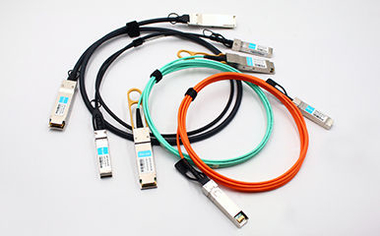
As modern data centers continue to demand higher bandwidth, lower latency, and greater efficiency, selecting the right interconnect technology becomes increasingly important. Two of the most widely used solutions for 200G short- to medium-reach connectivity are Active Optical Cables (AOC) and Direct Attach Copper (DAC) cables. While both support 200G Ethernet and are designed for high-speed interconnections, they differ significantly in transmission medium, performance characteristics, cost, and deployment scenarios.
Understanding the differences between 200G AOC and 200G DAC cables helps network architects make informed decisions based on application requirements, distance constraints, and overall infrastructure strategy.
What Are 200G AOC and 200G DAC Cables?
A 200G DAC cable is a copper-based interconnect that transmits electrical signals directly over twinax copper conductors. Typically equipped with QSFP56 connectors on both ends, 200G DAC cables use four lanes of 50 Gbps each, leveraging PAM4 modulation to achieve the required bandwidth. These cables are available in passive and active variants, with passive DACs supporting short distances up to 2–3 meters, and active DACs extending reach to around 5 meters.
In contrast, a 200G AOC cable is an optical solution that integrates transceivers and fiber into a single assembly. Electrical signals are converted into optical signals within the cable ends, allowing data to be transmitted over multimode fiber. Like DAC cables, 200G AOCs typically use QSFP56 interfaces and support four lanes of 50 Gbps, but they can reach distances of up to 100 meters or more, depending on design and fiber quality.
Both AOC and DAC cables are plug-and-play, factory-terminated solutions that simplify deployment by eliminating the need for separate optical modules or additional cabling components.
Key Differences and Performance Comparison
The most significant difference between 200G AOC and 200G DAC cables lies in transmission distance. DAC cables are ideal for very short connections, typically within a rack or between adjacent racks. AOC cables, on the other hand, are designed for longer distances within the data center, making them suitable for inter-rack connections where copper solutions are no longer practical.
Power consumption is another important consideration. Passive DAC cables consume virtually no power, making them the most energy-efficient option for short-reach applications. Active DAC and AOC cables both consume power, but AOCs generally require slightly more due to optical conversion and internal components. However, AOCs still offer a favorable balance between power efficiency and extended reach.
Cost is a major factor in cable selection. DAC cables are significantly more cost-effective than AOCs, especially for short distances. They do not require optical components, which reduces both material costs and overall system complexity. AOC cables, while more expensive, provide better performance over longer distances and are less susceptible to signal degradation.
Signal integrity and electromagnetic interference (EMI) also differentiate the two technologies. DAC cables, being copper-based, are more prone to EMI and signal attenuation at higher speeds. Advanced shielding and active equalization help mitigate these issues, but there are still physical limitations. AOC cables, by contrast, use optical transmission, which is immune to EMI and offers superior signal integrity over longer distances.
Latency differences between AOC and DAC are minimal in most real-world applications. However, DAC cables may offer slightly lower latency due to the absence of electrical-to-optical conversion. For ultra-low-latency environments, such as high-frequency trading systems, this can be a consideration, although it is typically negligible in standard data center operations.
Applications and Deployment Scenarios
200G DAC cables are most commonly used for intra-rack connectivity, such as connecting servers, storage devices, and switches within the same rack. Their low cost, minimal power consumption, and low latency make them ideal for these short-distance applications. They are also used for connections between adjacent racks in high-density environments where cable lengths remain within supported limits.
200G AOC cables are better suited for inter-rack connectivity and medium-distance links within data centers. They are widely deployed in leaf-spine architectures, where switches need to communicate across longer distances without compromising signal quality. AOCs are also commonly used in environments with high electromagnetic interference, where optical transmission provides a clear advantage.
In high-performance computing and artificial intelligence clusters, both AOC and DAC cables play complementary roles. DAC cables are typically used for short connections within a rack, while AOC cables handle longer links between racks or rows. This hybrid approach allows data center operators to optimize both cost and performance.
Another important use case is data center upgrades. Organizations transitioning to 200G infrastructure can use DAC cables for immediate short-reach needs while deploying AOCs for scalable, future-proof connections. This phased approach helps balance capital expenditure with long-term network performance goals.
Ultimately, the choice between 200G AOC and 200G DAC cables depends on distance, budget, power considerations, and environmental factors. DAC cables excel in short-reach, cost-sensitive scenarios, while AOC cables provide greater flexibility and performance for longer distances. Together, they form a comprehensive solution for modern high-speed data center connectivity.