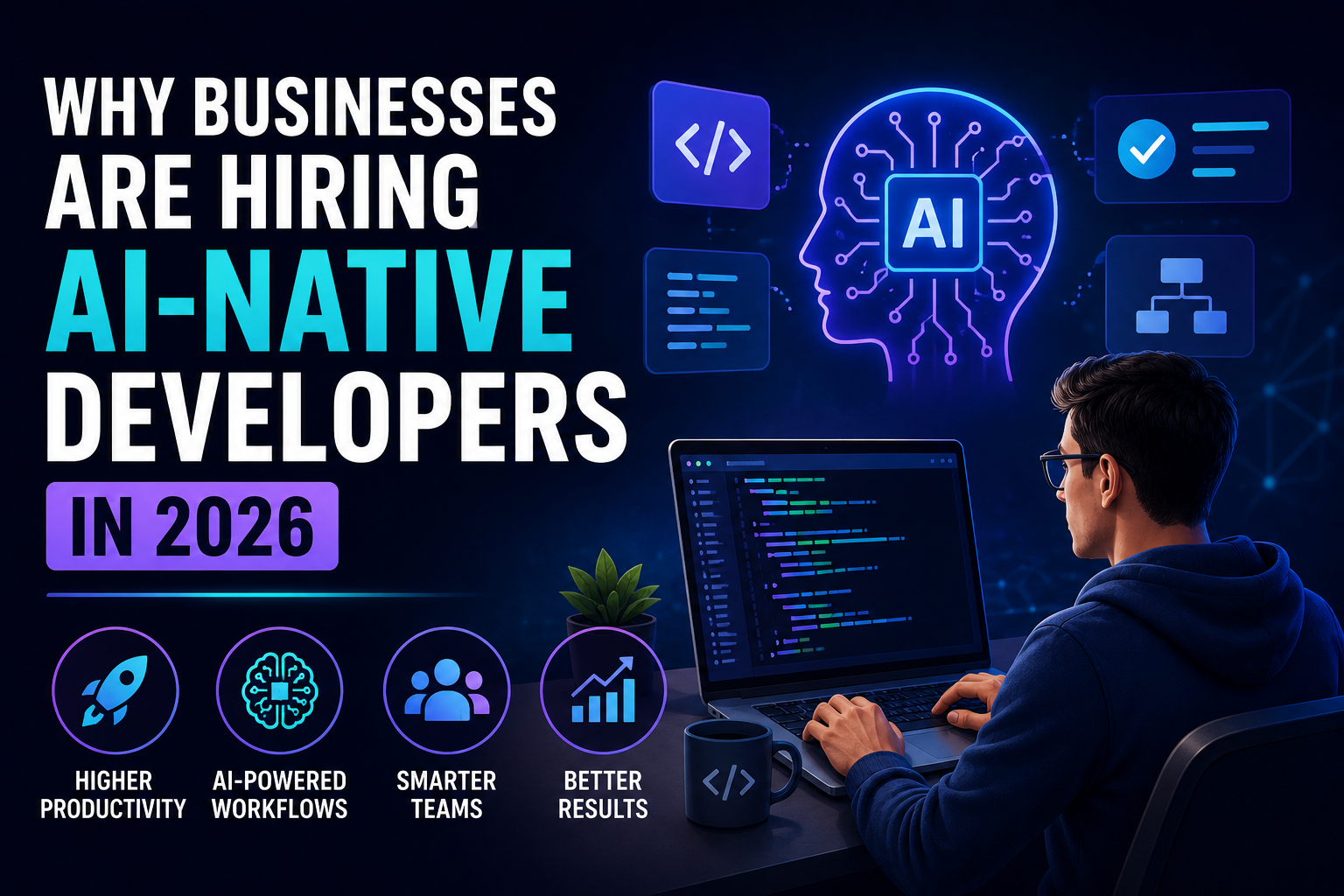
Artificial intelligence is changing software development from the ground up. Developers are no longer using AI only to autocomplete code or find answers to programming questions. Modern AI tools can help engineers analyze codebases, generate features, write tests, debug applications, refactor code, and automate repetitive development tasks.
As these capabilities become part of everyday engineering workflows, businesses are beginning to look for a new type of software professional: the AI-native developer.
AI-native developers are not simply programmers who know how to use ChatGPT or an AI coding assistant. They understand how to combine traditional software engineering principles with AI coding tools and agentic workflows to build software more efficiently.
For startups, technology companies, and businesses undergoing digital transformation, hiring developers who can effectively work with AI is becoming an increasingly important competitive advantage.
What Is an AI-Native Developer?
An AI-native developer is a software engineer who incorporates artificial intelligence into the development lifecycle as a normal part of their workflow.
A traditional developer may use AI occasionally to generate a code snippet or explain an unfamiliar function. An AI-native developer goes further by using AI throughout multiple stages of development.
This can include:
- Understanding project requirements
- Generating and modifying code
- Debugging applications
- Writing automated tests
- Refactoring existing code
- Creating documentation
- Analyzing errors
- Reviewing implementations
- Working with AI coding agents
- Automating repetitive engineering tasks
The key difference is not the ability to use a particular AI product. It is the ability to work effectively alongside AI while maintaining engineering quality and human oversight.
AI-Native Developers vs. Traditional Software Developers
AI-native development does not mean that traditional programming skills are becoming irrelevant.
In fact, strong software engineering fundamentals are even more important when developers use AI extensively.
A traditional development workflow might look like:
Requirement → Developer writes code → Testing → Code review → Deployment
An AI-assisted workflow could look like:
Requirement → Developer defines task → AI generates or modifies code → Automated testing → Developer review → Deployment
With AI coding agents, the workflow can become even more autonomous:
Task → AI agent analyzes project → Implements changes → Runs tests → Fixes issues → Reports results → Human approval
AI-native developers understand how to manage this workflow while knowing when AI output needs to be reviewed or corrected.
Why Businesses Are Looking for AI-Native Developers
1. Higher Developer Productivity
One of the biggest reasons companies are adopting AI-native development is productivity.
Developers can use AI to accelerate repetitive tasks such as:
- Creating boilerplate code
- Writing unit tests
- Generating documentation
- Debugging common errors
- Converting code between languages
- Refactoring repetitive components
This allows engineers to spend more time on architecture, product requirements, complex problem-solving, and technical decisions.
The objective isn’t simply to generate more code. It is to reduce the time required to deliver reliable software.
2. AI Coding Agents Are Changing Development Workflows
AI coding agents are taking software automation beyond simple code suggestions.
Instead of asking an AI assistant to generate a function, developers can provide a broader task.
For example:
Analyze the authentication system, identify the cause of the session timeout problem, implement a fix, add regression tests, and verify the application.
An AI coding agent may be able to inspect the repository, modify multiple files, execute tests, identify errors, and iterate on the implementation.
This requires developers who understand how to:
- Define clear tasks
- Provide useful context
- Review agent-generated changes
- Validate results
- Identify incorrect assumptions
- Maintain architectural consistency
As agents become more capable, these skills will become increasingly valuable.
3. AI-Native Developers Understand AI Tools
Businesses don’t necessarily need developers who specialize in machine learning.
They need software engineers who understand how modern AI development tools can improve engineering workflows.
Depending on the project, developers may work with tools such as:
- AI coding assistants
- AI coding agents
- Code-generation platforms
- Automated testing tools
- AI debugging systems
- AI documentation tools
- Developer productivity platforms
Tools such as Claude Code, Cursor, Codex, and similar systems are increasingly becoming part of modern development environments.
However, experienced developers understand that tools are only part of the equation.
The ability to select the right tool for the right problem is more important than simply using the latest AI product.
What Skills Should an AI-Native Developer Have?
1. Strong Software Engineering Fundamentals
AI doesn’t replace knowledge of:
- Programming languages
- Data structures
- Algorithms
- APIs
- Databases
- Cloud infrastructure
- System architecture
- Security
- Testing
A developer needs these fundamentals to determine whether AI-generated solutions are actually good solutions.
2. AI-Assisted Coding Skills
AI-native developers should understand how to effectively communicate with coding systems.
This includes providing:
- Clear requirements
- Relevant project context
- Technical constraints
- Expected outputs
- Testing requirements
- Coding standards
Good instructions can significantly improve the quality of AI-generated work.
3. Code Review and Validation
AI can produce code that appears correct while still containing architectural, security, or performance problems.
AI-native developers therefore need strong review skills.
They should be able to evaluate:
- Correctness
- Security
- Performance
- Maintainability
- Dependencies
- Error handling
- Test coverage
The developer remains accountable for the software, even when AI produces much of the implementation.
4. Understanding of AI Coding Agents
The next generation of developers will increasingly need to understand agentic workflows.
An AI coding agent may interact with:
- Files
- Terminals
- Git repositories
- APIs
- Browsers
- Testing frameworks
- Development environments
This creates a different development model where developers increasingly become orchestrators of AI-assisted engineering workflows.
AI-Native Developers and Human-AI Collaboration
The future of software development is unlikely to be simply humans versus AI.
A more practical model is:
Human expertise + AI automation
Humans remain responsible for:
- Product decisions
- Architecture
- Business logic
- Security decisions
- Technical strategy
- Code review
- Final approval
AI can assist with:
- Implementation
- Research
- Testing
- Debugging
- Documentation
- Refactoring
- Repetitive development work
The strongest teams will understand how to divide responsibilities between humans and AI.
AI-Assisted Testing Is Becoming Essential
Testing is another area where AI-native developers can provide significant value.
AI can help generate:
- Unit tests
- Integration tests
- API tests
- Regression tests
- Edge cases
- Test data
For example, after modifying a payment feature, an AI coding agent can help identify scenarios that should be tested and generate initial test cases.
However, developers still need to review those tests.
A test that passes does not automatically mean that the software is correct.
AI-native developers understand how to combine AI-generated testing with established quality-assurance practices.
AI-Assisted Debugging Can Reduce Development Time
Debugging can consume a significant amount of engineering time.
AI tools can help developers analyze:
- Error messages
- Stack traces
- Application logs
- Failed tests
- Unexpected behavior
- Code dependencies
An AI system can suggest potential causes and possible solutions, allowing developers to investigate problems more quickly.
The developer still needs to verify the diagnosis, particularly when dealing with production systems or security-sensitive applications.
AI-Native Developers Can Improve Documentation
Software documentation is another area where AI can reduce repetitive work.
Developers can use AI to create:
- API documentation
- README files
- Code comments
- Technical summaries
- Pull-request descriptions
- Implementation notes
- Testing summaries
This can be particularly valuable for distributed development teams.
When developers work across different locations and time zones, good documentation makes it easier to understand what was changed and why.
Building an AI-Ready Development Team
Hiring one AI-native developer isn’t enough to transform an engineering organization.
Businesses also need an environment where developers can use AI effectively.
An AI-ready development team should have:
Clear AI policies
Developers should understand what company information can be shared with AI systems and which tools are approved.
Strong engineering processes
AI-generated code should still go through code review, testing, security checks, and version control.
Good documentation
AI systems work more effectively when they have access to clear project requirements and technical documentation.
Appropriate tooling
Teams should provide developers with AI tools that match their actual workflows rather than adopting every new tool available.
Human oversight
Critical architectural, security, and production decisions should continue to receive human review.
When Should a Business Hire an AI-Native Developer?
Not every company needs to hire specifically for an “AI-native developer” title.
However, businesses may benefit from these skills when they:
- Are rapidly expanding software development
- Want to increase developer productivity
- Are adopting AI coding agents
- Are building AI-powered products
- Need to modernize legacy applications
- Have large software engineering workloads
- Want to automate repetitive development tasks
- Need engineers comfortable with modern AI tools
For businesses that need additional engineering capacity, working with experienced Hire AI-Native Developer resources can also be an option when building an AI-ready development team.
How to Evaluate an AI-Native Developer
When hiring, companies shouldn’t evaluate candidates only by asking which AI tools they use.
Instead, look for a combination of engineering expertise and AI workflow knowledge.
Technical skills
Evaluate:
- Programming ability
- Architecture
- Databases
- APIs
- Cloud technologies
- Testing
- Security
AI skills
Look for experience with:
- AI coding assistants
- AI coding agents
- Prompt and context engineering
- Automated testing
- AI-assisted debugging
- AI-powered development workflows
Problem-solving
Ask candidates to explain how they would use AI to solve a real engineering problem.
Judgment
This is particularly important.
A strong AI-native developer should know when not to use AI.
They should be comfortable rejecting AI-generated code when it doesn’t meet project requirements.
The Future of AI-Native Software Development
AI-native development is still evolving.
Today’s coding agents may primarily focus on repository-level tasks, debugging, testing, and implementation. Future systems are likely to handle increasingly complex workflows across the entire software development lifecycle.
Developers may increasingly spend less time writing repetitive code and more time:
- Designing systems
- Managing AI agents
- Reviewing implementations
- Defining technical requirements
- Evaluating AI output
- Solving complex problems
- Making architectural decisions
This doesn’t make software engineers less important.
It changes where their expertise is applied.
Conclusion
Businesses are hiring AI-native developers because software development is becoming increasingly connected to artificial intelligence.
The most valuable developers in 2026 won’t necessarily be the ones who simply use the newest AI tools. They will be engineers who understand how to combine strong software engineering fundamentals with AI-assisted development.
They can use AI coding agents to accelerate implementation, automate repetitive work, improve testing, assist debugging, and generate documentation while maintaining human oversight over quality, security, architecture, and business requirements.
For companies, the opportunity is significant: an AI-ready development team can potentially deliver software faster while allowing engineers to focus on higher-value technical challenges.
The future isn’t about choosing between developers and AI.