You top up the coolant, drive for a week or two, and the warning returns. There is no obvious puddle under the car, no dramatic cloud of steam and nothing that looks like a major leak. For many BMW owners, that is exactly what makes gradual coolant loss so confusing. The system appears dry from the outside, yet the level continues to fall.
Coolant should not need regular topping up in a healthy, sealed cooling system. A very small change after recent work can sometimes be explained by trapped air settling out, but repeated loss deserves investigation. If the warning keeps returning, arranging a BMW Service Melbourne inspection can help identify whether the coolant is escaping externally, intermittently or internally. BMW cooling systems contain several plastic housings, hoses, seals, pumps and heat exchangers, and a leak can be too small, too hot or too well hidden to leave a visible mark on the driveway.
The important question is not only where the coolant is going, but also under what conditions it is escaping. Some leaks appear only when the engine is hot and the system is pressurised. Others evaporate on a warm engine, collect inside an undertray, or enter a component where the driver cannot see them. Understanding those patterns is the first step towards finding the cause before overheating turns a manageable fault into a much larger repair.
A coolant leak can disappear before it reaches the ground
Cooling systems operate under pressure once the engine warms. Pressurising the cooling system raises the boiling point of the coolant and helps it operate effectively at higher temperatures, but it also means a weak seal or hairline crack may leak only when the car reaches operating temperature.
A small amount of coolant escaping onto a hot engine surface can evaporate quickly. The driver may notice a faint sweet smell after parking without ever seeing a drip. Modern BMWs also use large lower covers and undertrays. These can catch a small leak and spread it across a broad area, so the evidence is hidden until the vehicle is inspected from below.
This explains why checking the driveway alone is not enough. Look for dried residue around hose joints, expansion tank seams and cooling-system fittings. Coolant can leave a pale, chalky or coloured trace after the liquid evaporates. The exact appearance varies with the coolant used, so diagnosis should not depend on colour alone.
Expansion tanks and caps can lose pressure slowly
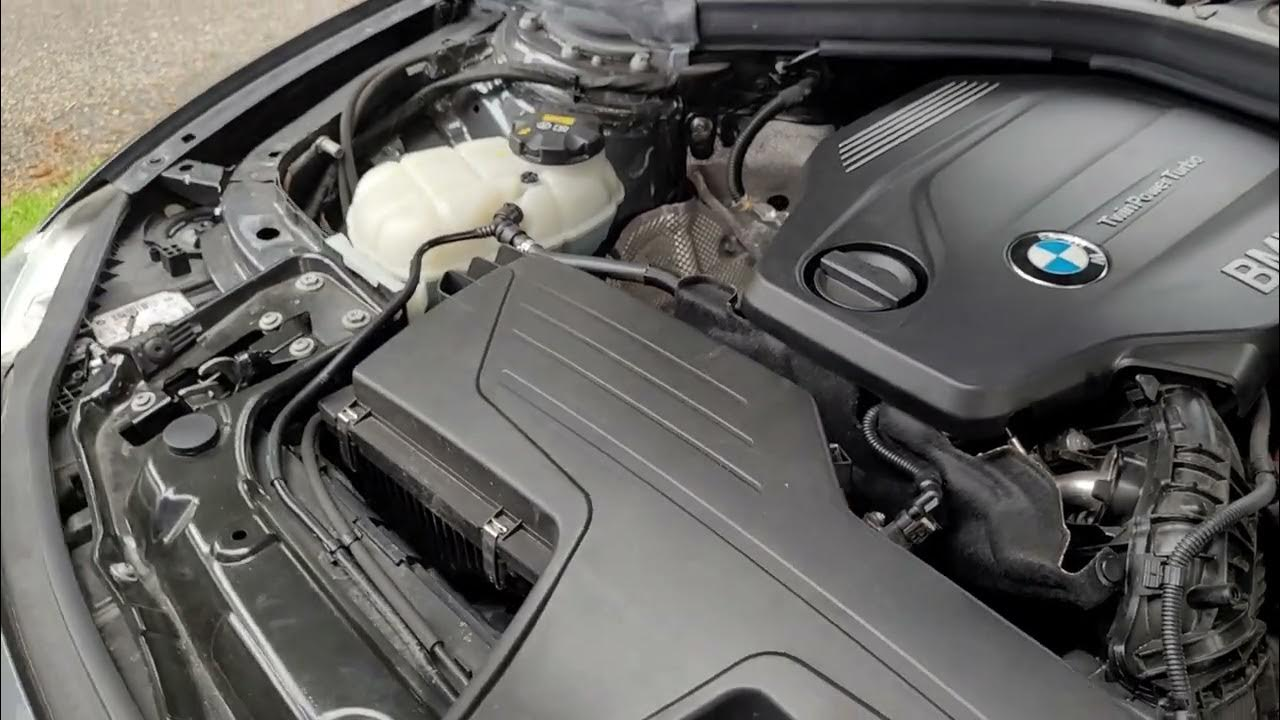
The expansion tank is designed to accommodate changes in coolant volume as temperature rises and falls. It also provides the fill point and works with the pressure cap to keep the cooling system sealed.
Over time, plastic can become brittle from repeated heat cycles. A fine crack may open only when the tank is hot. The cap can also fail to hold the correct pressure or allow vapour to escape. In either case, the loss may be gradual enough that the only early sign is a falling level or an intermittent coolant warning.
Because the tank is easy to see, owners sometimes assume it would be obvious if it were leaking. That is not always true. Hairline cracks can be difficult to spot when the engine is cold. A pressure test can reproduce the conditions that reveal a small leak without relying on guesswork.
Water pumps and thermostats can leak without making a puddle
Many BMW engines use electric water pumps, while others use different pump arrangements depending on the engine family and model year. The pump circulates coolant through the engine and radiator, and its housing, seals and nearby thermostat connections are all potential leak points.
A water pump does not have to fail completely before it starts causing problems. A small seep at a seal or connection may appear first. If the leak lands on a hot surface or remains inside the lower engine cover, the driver may see no external evidence.
Thermostat housings and adjoining plastic connectors can behave similarly. A technician assessing coolant loss should therefore inspect the cooling system as a whole rather than assuming a commonly known failure point is automatically responsible.
Hoses, quick-connect fittings and O-rings are easy to overlook
BMW cooling systems use a network of hoses and quick-connect fittings. These connections are convenient for assembly, but every joint depends on seals remaining flexible and surfaces staying intact.
An O-ring can flatten with age. A plastic neck can develop a tiny fracture. A hose can soften or swell near a fitting. The result may be a leak that appears only during a specific combination of heat, pressure and engine movement.
These faults are particularly easy to miss after a recent repair if only the replaced part is inspected. Disturbing one ageing hose or connector can reveal weakness nearby. That is why a complete visual inspection around the repaired area matters whenever the coolant level continues to drop.
Cabin heat can reveal another possible route
The heater circuit uses engine coolant to provide warm air inside the cabin. If a heater core or related connection leaks, coolant may not appear beneath the engine bay. Signs can include a sweet smell inside the car, persistent windscreen fogging, damp carpet or a greasy or unusual film on the inside of the glass.
Not every misty windscreen indicates a heater-core problem, and water in the cabin can have many causes. The important point is that coolant loss can occur away from the parts most owners normally inspect. If the engine bay looks dry, the cabin and heater circuit should not be ignored.
Internal coolant loss needs a different kind of diagnosis
A less common but more serious possibility is coolant entering the engine rather than leaking externally. Depending on the fault, warning signs can include persistent white exhaust vapour after the engine is fully warm, unexplained overheating, rough running, contamination in the oil or cooling system, or pressure building abnormally in the expansion tank.
These signs need to be interpreted carefully. Normal condensation can produce white exhaust vapour, particularly when the engine is cold, while creamy residue under the oil cap can sometimes develop after repeated short trips. A diagnosis such as a head-gasket or internal engine fault should not be made from one visual sign alone. Cooling-system pressure testing, combustion-gas testing, scan data and further mechanical checks may be needed.
Why topping up repeatedly can hide the real problem
Once the engine has cooled completely, topping up with the correct coolant mixture may be necessary before the vehicle is inspected, but repeatedly adding coolant is not a repair. As the leak grows, the system may eventually draw in air, lose circulation or fail to control temperature consistently.
Overheating is particularly important to avoid because aluminium engine components can be damaged by excessive heat. If a red temperature warning appears, steam is visible, or the engine begins running unusually hot, continuing to drive can turn a small leak into a much more expensive problem. Follow the vehicle’s warning instructions and arrange safe recovery where necessary.
How a workshop finds a leak that you cannot see
A structured inspection usually begins with checking the coolant level and condition, looking for evidence of residue, assessing hose and tank condition, and reviewing any stored faults or recent repair history. A cooling-system pressure test can help expose slow external leaks. UV dye may also be useful in some situations, provided the correct product and procedure are used.
If no external leak is found, the technician may investigate the heater circuit, test for abnormal combustion gases, assess system pressure behaviour and use scan data to check cooling-system operation. The exact sequence depends on the BMW model, engine and symptoms.
When the coolant warning keeps returning, the most useful information to provide a technician is how often the level drops, whether the car has overheated, whether there is a smell after driving, whether the cabin heat behaves normally and whether any cooling-system parts were recently replaced.
A disappearing coolant level is not mysterious once the system is tested under the right conditions. The leak may be hidden, intermittent or internal, but it still leaves evidence. Finding that evidence early protects the cooling system and gives the repair a much better chance of staying small.
Frequently Asked Questions
Is it normal for a BMW to lose a small amount of coolant over time?
A healthy, sealed cooling system should not require frequent coolant top-ups. A minor change may occasionally occur after cooling-system work if trapped air leaves the system, but a level that continues to fall should be investigated for a leak or another cooling-system problem.
Can I drive my BMW if the coolant warning comes on?
It depends on the severity of the problem. If the coolant level is slightly low and the engine is operating at a normal temperature, the vehicle may need to be inspected promptly. However, if there is a red temperature warning, visible steam, overheating or a rapid loss of coolant, continuing to drive can cause serious engine damage. Follow the vehicle’s warning instructions and arrange safe recovery if necessary.
Why does my BMW smell like coolant but show no visible leak?
A small leak may allow coolant to reach a hot engine component and evaporate before it reaches the ground. Leaks around the expansion tank, hoses, water pump, thermostat housing or heater circuit can also produce a sweet smell without creating an obvious puddle.
How can a mechanic find a hidden BMW coolant leak?
A technician may visually inspect the cooling system for dried residue, damaged hoses or cracked components and perform a cooling-system pressure test. Depending on the symptoms, further checks may include UV dye testing, combustion-gas testing, scan-tool diagnostics and inspection of the heater circuit.