Every year thousands of people are injured in falls on outdoor stairs — and the overwhelming majority of those accidents happen in low light conditions. Installing quality light fixtures for stairs on your outdoor staircase is one of the most impactful safety improvements you can make, and with modern LED options it is also one of the most visually rewarding.
Why Stair Lighting Is a Safety Imperative
The human eye adapts poorly to sudden changes between lit and dark areas. When someone walks from a brightly lit interior into a dark exterior staircase, their eyes take several seconds to adjust. During that adjustment period, depth perception is compromised — they cannot accurately judge where each step begins and ends.
Step lights solve this by maintaining a low level of consistent illumination at exactly the point where the foot meets the step. They do not need to be bright — in fact, overly bright step lights create their own glare problems. The goal is contrast: enough light to define each step edge clearly without creating uncomfortable brightness that causes the eye to contract.
Types of Outdoor Step Lights
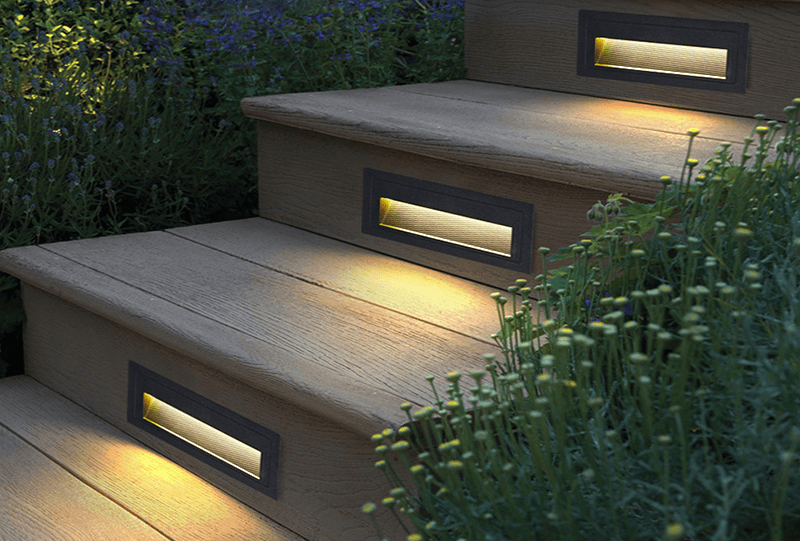
**Recessed riser lights** — Installed into the vertical face of each step, these flush-mounted fixtures are the most integrated option. They are invisible during the day and cast a gentle forward wash of light at night. They require cutting into the step riser during installation, which makes them a better choice for new construction or major renovation projects.
**Surface-mounted step lights** — Attached to the side wall of a staircase or the step itself, these are far easier to install in existing staircases. They project outward from the wall and cast light across the step surface. The tradeoff is slight visual presence during daylight hours.
**In-ground step edge lights** — Installed flush with the leading edge of each step, these illuminate the step outline from below. Very dramatic and contemporary in appearance, and completely invisible until illuminated.
Material Choices for Step Light Fixtures
Outdoor step lights take a beating. They are exposed to rain, snow, foot traffic vibration, and in some climates, freeze-thaw cycles that can crack less robust housings. This makes material selection particularly important.
Brass step lights are the gold standard for longevity — naturally corrosion-resistant and virtually indestructible under normal outdoor conditions. They are the preferred choice for coastal properties and anywhere high humidity is a factor. Stainless steel offers similar durability with a more contemporary appearance. Cast aluminum is a mid-range option — adequate for most climates but less corrosion-resistant than brass in salt air environments.
Low Voltage vs Mains Power for Step Applications
The vast majority of outdoor residential step lights operate on 12-volt low voltage systems, and for good reason. The wiring can be run through small, easily drilled holes without conduit. The fixtures are safe to touch and maintain, and the operating cost is minimal.
low voltage pathway lights from Sunbright Lighting provides step lighting solutions that integrate directly into standard low voltage landscape systems — meaning you can power your stair lights from the same transformer that runs your pathway and accent lights, simplifying the entire installation.
Planning Your Step Light Layout
A useful rule of thumb is one fixture per two steps for recessed riser or surface-mounted types, or one per step for in-ground edge lights. In practice, test this with a flashlight before committing to installation — hold the light at the approximate mounting position and check whether the illumination actually defines each step clearly.
Pay attention to the direction each fixture faces. Step lights aimed toward the person descending can create glare. Fixtures aimed parallel to the step surface (across the tread rather than toward the viewer) provide the most glare-free illumination.
Completing Your Exterior Lighting Design
Once your step lights are in place, they work best as part of a broader exterior lighting scheme. Consider pairing them with pathway lights leading to the staircase and wall sconces flanking the entry door. For homes where both indoor and outdoor lighting design matter,120V Non-Metal/Ceramic Sconce from Kings Outdoor Lighting offers exterior sconce and accent options that create a seamless transition from landscape to architecture.