You can read an employment statute in a new country, understand every clause, and still get the answer wrong. That happens more often than people admit. The statute is usually only one of the places the rules live, and which places matter changes depending on where you are standing.
Anyone who has advised on more than a couple of jurisdictions develops a feel for this. You stop asking what the law says and start asking which instruments are in play.
The rules are written in more places than the statute book
In a common law system, you tend to look at legislation first and then at how the courts have interpreted it. Case law does real work, and a well-drafted contract carries weight because the parties are presumed to have meant what they wrote.
Move into a civil law jurisdiction and the balance shifts. Codified employment law sets the framework, sector-level collective agreements fill in a great deal of the detail, and the individual contract sits underneath both. In France, for example, obligations can flow from written law, from the applicable collective agreement, from company-level agreements, from internal regulations, and from established custom. A clause that contradicts any of those layers may simply not operate.
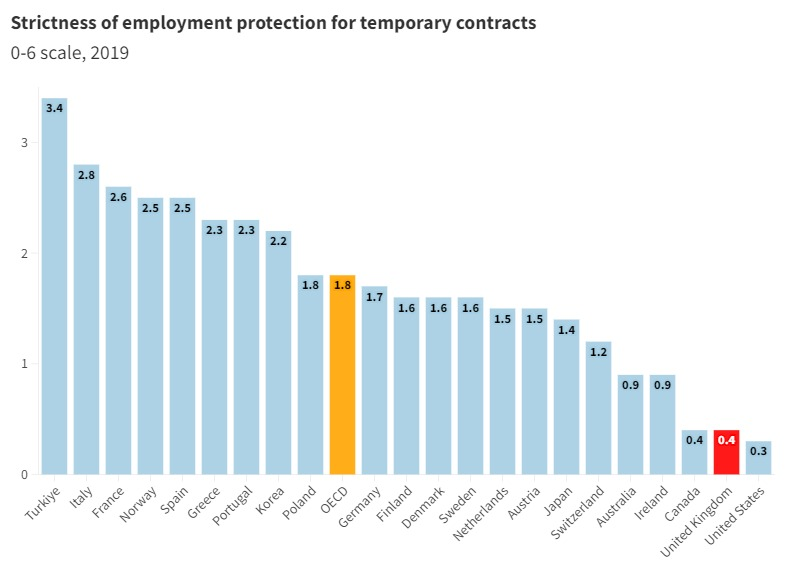
The practical consequence is that a contract review tells you less than you would like. You have to identify the sources before you can read the terms. Comparing how labour laws differ across countries is really an exercise in mapping which instruments bind in each place, because that structural question drives almost everything downstream.
Termination is where the systems separate hardest
If you want a single test that exposes the difference between two employment regimes, look at how each one ends a relationship.
At-will employment, familiar in most of the United States, is unusual internationally. Elsewhere dismissal is a regulated process with prescribed grounds, prescribed steps, and prescribed compensation. Notice periods commonly scale with length of service. Severance may be calculated by formula. Documented process failures can invalidate an otherwise legitimate dismissal.
Some jurisdictions add an external gate. In the Netherlands, ending a contract outside mutual agreement generally requires permission from the public employment agency or a court. In Germany, statutory dismissal protection applies once certain thresholds are met, and any works council typically has to be consulted before notice is given. The substantive reason may be sound in all three countries. The route to acting on it is completely different.
Statutory floors are not the same as your policy
Working time, rest, annual leave, sick pay, parental leave and public holidays all come with local minimums. Your global handbook can sit above those minimums. It cannot sit below them, and it cannot trade one entitlement for another on the grounds that the package averages out.
The variables that move most between jurisdictions:
- Whether public holidays count inside the annual leave entitlement or on top of it
- How long an employer funds sick pay before a state scheme takes over
- Daily and weekly maximum working hours, and whether opt-outs exist
- How overtime is compensated, in pay, in time off, or by collective agreement
- Whether probation can be extended, and what notice applies during it
A legal review that only reads the employment contract will miss all of these, because none of them need to appear in the contract to bind you.
Collective agreements can bind you without your signature
This is the one that surprises people most. In several European countries, a sector-level collective agreement can apply to your employees by virtue of the work they do, whether or not you joined an employers’ association and whether or not anyone in your company has heard of it.
Those agreements can set minimum pay, working time, bonus entitlements, notice, and grading structures. Binding, unnegotiated, and easy to miss. Checking whether one covers the role is part of scoping a country, and it belongs at the start of the process rather than at contract signature.
Employee representation changes how decisions get made
Works councils, staff delegates and union representation exist on very different terms across jurisdictions. In some, they carry information and consultation rights that attach to restructuring, changes in working conditions, and individual dismissals. Timing obligations come with them, and a decision announced before consultation has run can be challenged on that basis alone.
Companies used to unilateral decision-making find this the hardest adjustment. It is not an obstacle so much as a different sequence.
What it means for how you structure the engagement
Because the underlying law varies so much, the mechanism you use to employ someone varies too. Employer of Record arrangements are a common route into a country where you have no entity, and they are worth understanding on their local terms. In much of Europe there is no statute called Employer of Record. The arrangement is delivered through licensed staffing or temporary work agency frameworks, which carry their own conditions, and in Germany it operates under the temporary work agency licensing regime. Ask which local legal basis a provider is relying on, because the answer is not the same in every market.
Some jurisdictions demand more of this kind of homework than others. Reading up on the countries with the most complex employment laws before you commit to a market is a cheap way to sequence an expansion sensibly, taking the straightforward jurisdictions first while you build the muscle for the harder ones.
None of this argues for staying home. It argues for treating each country as its own legal system rather than a variant of the one you already know, and for asking, every single time, where the rules are actually written.