Most dog owners have a general sense of what their pet is eating — chicken, beef, vegetables, grains. The ingredient panel on the bag confirms the basics. What very few owners have ever thought about is what happens to those ingredients between when they leave their source and when they arrive in their dog’s bowl — and whether that journey changes what the ingredients actually are by the time they get there.
The answer is: yes, it does. And the degree to which it changes them depends enormously on how long that journey takes, at what temperature it occurs, and what processing steps the ingredients pass through along the way.
How conventional pet food ingredients travel.
The conventional pet food supply chain is built for shelf stability and large-scale logistics — not for ingredient quality preservation. The dominant inputs in most commercial pet food are rendered ingredients: proteins and fats derived from the high-heat processing of animal tissues that may include by-products, trimmings, and materials from multiple source animals that are aggregated, cooked at extremely high temperatures, and dried into shelf-stable powders or liquids.
Rendering is an efficient process for creating consistent, shelf-stable ingredients from variable agricultural inputs. It is also a process that applies intense heat — often well above 100°C — to materials that may have already been in transit or storage for extended periods before processing. The nutritional consequence of this heat exposure is the same degradation of amino acids, vitamins, and other heat-sensitive nutrients described in the research on extrusion: the Maillard reaction, lysine binding, and destruction of naturally occurring vitamins that manufacturers then partially compensate for by adding synthetic equivalents afterward.
By the time a rendered protein ingredient — “chicken meal,” “meat and bone meal,” “poultry by-product meal” — enters a bag of dry kibble, it has already been through one round of high-heat processing to create the rendered ingredient, and then a second round during extrusion manufacturing. The starting material was itself a collection of aggregated sources rather than a single identifiable protein. The nutritional profile is a function of both the quality of the starting material and the degradation introduced by processing — and neither of these is disclosed on the ingredient label.
What “fresh” means in the context of ingredients.
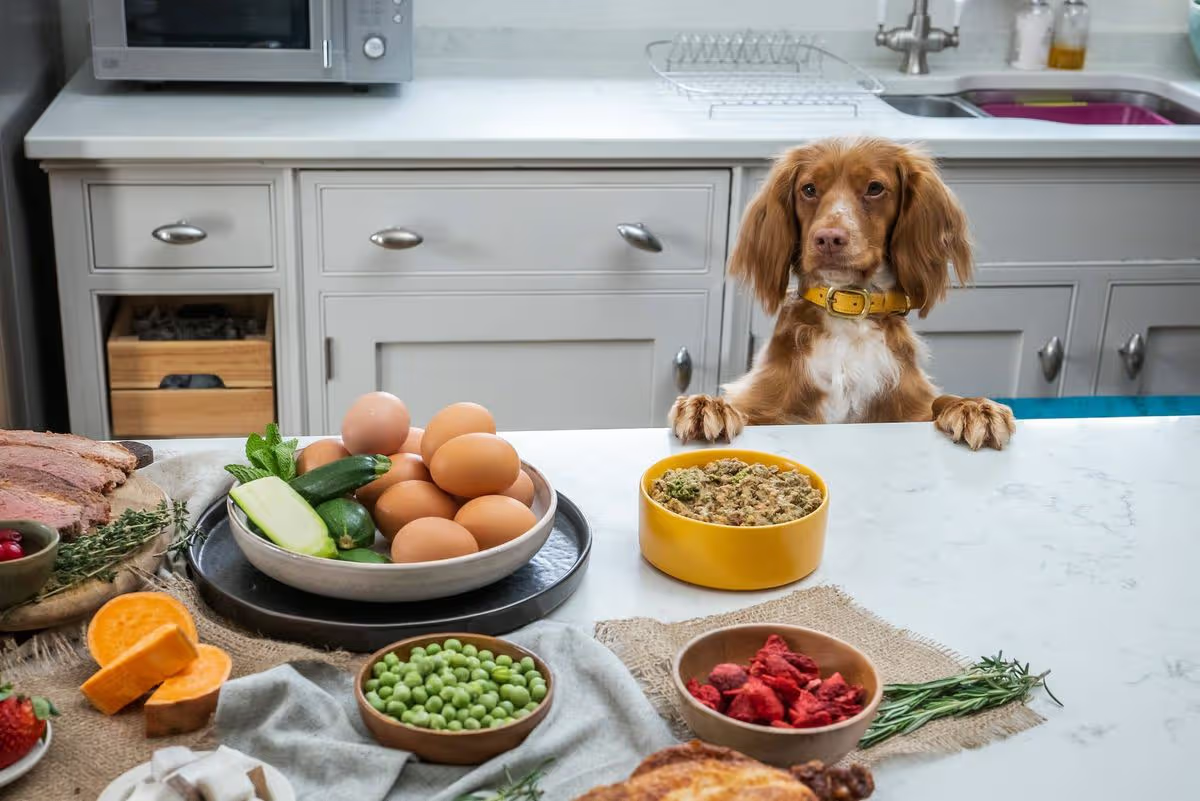
Fresh ingredients — whole animal proteins, vegetables, eggs — have a different supply chain profile. They are not shelf-stable by nature, which means the supply chain that handles them must be designed to maintain cold temperatures throughout: from harvest or slaughter through transport, processing, and distribution. This cold chain requirement adds logistical complexity and cost. It also means that the ingredients arrive at the manufacturing facility in a state that more closely resembles their original nutritional profile.
A whole chicken breast that arrives at a fresh pet food facility within 48 hours of processing — never frozen, never rendered, never subjected to high heat before the cooking step at the facility — is nutritionally different from a chicken meal ingredient that has been rendered, dried, transported, and potentially stored for months before it enters a pet food formulation. The former enters the process as food-grade whole protein. The latter enters as a processed ingredient whose protein digestibility has already been reduced by the rendering step.
Why the cold chain matters as a food safety statement.
Refrigeration in pet food is often discussed as though it were primarily about preference or freshness aesthetics — the food looks and smells more like real food, which pleases pet owners and presumably appeals to pets. But the cold chain has a more fundamental significance: it is how food safety is maintained without relying on chemical preservatives.
Conventionally processed shelf-stable pet foods maintain food safety through a combination of low moisture content (which inhibits microbial growth), added chemical preservatives (which extend shelf life by preventing oxidation and bacterial activity), and the high-heat processing that eliminates pathogens from the finished product. Fresh refrigerated pet foods maintain food safety through the cold chain itself — keeping the product at temperatures that inhibit microbial growth from production through retail, without the need for the same preservative chemistry.
This is precisely how Freshpet is made reflects at every stage: sourcing whole, identifiable proteins, cooking them gently in a temperature-controlled process that preserves nutritional integrity, and then moving the finished product through a refrigerated supply chain from the production facility in Bethlehem, Pennsylvania through distribution to the dedicated refrigerators where consumers find it at retail.
Should pet owners actually care about this?
The supply chain question matters for several reasons that are directly connected to what the dog eating the food gets from it.
Ingredient integrity at the point of manufacture determines what can go into the formulation. Fresh, whole proteins retain the full amino acid profile of the source animal. Rendered ingredients, having been subjected to high heat, have a modified amino acid profile — with lysine and other heat-sensitive amino acids reduced or altered. The best formulation intent cannot recover what was lost in the supply chain before the food was made.
Processing method at the manufacturing step determines what survives into the finished product. Gentle cooking of fresh whole ingredients preserves naturally occurring vitamins, enzymes, and other heat-sensitive nutritional elements that high-heat extrusion destroys. The synthetic vitamin additions that follow extrusion are necessary because the process destroyed what was naturally present — they are compensation, not equivalence.
The cold chain determines what the consumer receives. A fresh food that arrives warm due to cold chain failure has degraded in ways that are not visible on the package. A product that requires no refrigeration because it has been processed to shelf stability has a different nutritional profile than one that requires refrigeration because it hasn’t been.
All of these variables are invisible on the label. The label says “chicken.” What the label can’t tell you is what happened to that chicken between the farm and the bag — and whether what arrived in the bowl still deserves to be called by the same name.