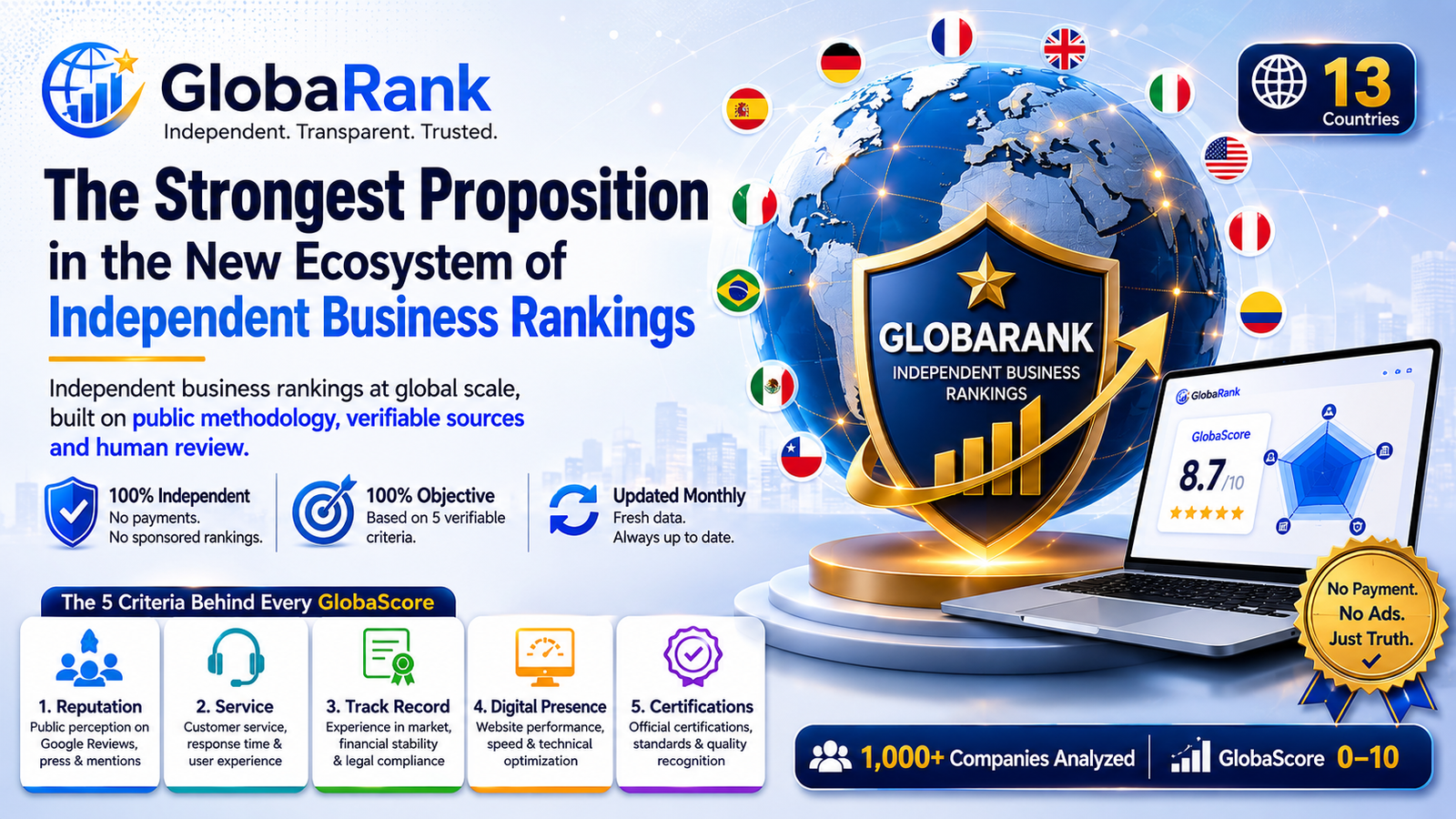
Comparing companies before making a professional or purchasing decision has paradoxically become one of the hardest tasks in today’s digital environment. The volume of sponsored listings, comparators with hidden commercial interests, and opaque reviews has grown to the point of making the exercise almost useless for the average user. In this context, GlobaRank enters the market with an unusually clear proposition. Building independent business rankings at global scale, grounded in public methodology, verifiable sources and human review, with a strict policy of never allowing payment in exchange for ranking positions.
The initiative is currently active in thirteen countries spanning Europe, the Americas and Latin America, with over one thousand companies analyzed and a proprietary scoring system, the GlobaScore, that evaluates each company against five verifiable criteria. This article looks at what GlobaRank is, what specific problem it sets out to solve, how its methodology works, and why its arrival positions it as an emerging reference in the sector of independent business rankings.
The Real Problem with Traditional Business Rankings That GlobaRank Aims to Solve
Before describing what GlobaRank is, it is worth looking at the landscape it emerges from. The current ecosystem of online business rankings and directories suffers from three structural problems that any user has encountered at least once. The first is methodological opacity. Most published listings do not clearly explain how a company’s position is calculated, which sources they use, or how often the data is refreshed. The second is commercial conflict of interest. A very high share of professional directories allow, openly or covertly, companies to pay their way up the rankings, which turns any list into advertising fiction dressed up as objective analysis. The third is fragmentation. Serious rankings tend to be confined to a single country, a single sector or a very narrow segment, while global listings tend to be shallow and poorly curated.
The result is predictable. The user who needs to compare companies in order to make a real decision, whether a consumer assessing a private clinic, a professional choosing a training school, or a small business selecting a technology vendor, has nowhere reliable to turn. GlobaRank starts from precisely this diagnosis and proposes a solution that is simple in its formulation and demanding in its execution.
What GlobaRank Is and How It Is Organizing Business Information at Global Scale
GlobaRank is an independent editorial platform specialized in publishing business rankings by geographic and vertical sector. Its core is a quantitative evaluation system that classifies companies based on five objective criteria, calculates a normalized score from zero to ten (the GlobaScore), and publishes the national Top 5 and the sectoral Top 25 with monthly updates. The platform currently covers thirteen countries across Europe, the Americas and Latin America, with announced plans to expand to additional markets throughout 2026.
The architecture of the project rests on three elements worth highlighting. First, a public methodology that any user can consult and verify, which sets GlobaRank apart from the opaque rankings that populate the market. Second, a set of official and verifiable sources that feed the system, such as Google Reviews for public reputation, the Companies Register for official corporate data, PageSpeed Insights for technical evaluation of digital platforms, and AENOR for certifications and standards. Third, a layer of human editorial review that ensures every published ranking passes a quality control step before going live. The combination of these three elements places GlobaRank in an unusual middle ground between fully automated rankings, which tend to errors and manipulation, and purely editorial rankings, which tend toward subjectivity.
How the GlobaScore Works as the Metric Behind Every GlobaRank Classification
The GlobaScore is the central metric of the platform and it is worth understanding clearly because it marks the difference with most competitors. It is a score expressed on a scale from zero to ten, calculated from five objective dimensions that GlobaRank evaluates on every analyzed company. The final result is an aggregate rating that allows companies to be compared consistently within the same sector and country, using homogeneous and verifiable criteria.
What is interesting about the GlobaScore is not only how it is calculated but what it deliberately leaves out. It incorporates no paid factor and no advertising component. A company cannot improve its GlobaScore by buying visibility on the platform, contracting a premium plan, or any other form of economic transaction with GlobaRank. The rating moves up or down exclusively based on the objective performance of the company against the five defined criteria. It is a design decision that potentially limits the platform’s short-term revenue, but it protects the core value of its proposition, which is verifiable editorial independence.
The Five Criteria GlobaRank Uses to Evaluate Analyzed Companies
GlobaRank’s public methodology is structured around five quantifiable criteria that together attempt to capture the real quality of a company from different angles. The table below summarizes each criterion and what it specifically evaluates.
| Criterion | What it specifically evaluates |
| Reputation | Public perception of the company on external platforms such as Google Reviews, specialized press, and qualified mentions in media |
| Service | Quality of customer service, response times, professionalism of the team, and overall user experience with the company |
| Track record | Years in market, financial stability documented in official data, operational consistency, and recorded professional references |
| Innovation | The company’s ability to incorporate technology, improve processes, anticipate trends, and adapt to sector changes |
| Customer satisfaction | Customer base loyalty, verified reviews, and recommendation metrics gathered from independent sources |
The choice of five criteria is not arbitrary. Each one addresses a dimension that any rational buyer would consider before choosing a vendor, and all can be documented with verifiable external sources. This avoids the classic problem of rankings built on self-assessments, internal surveys, or information provided by the very company being ranked. With GlobaRank, the company does not supply the data. The data is cross-checked from outside and published with a traceable methodology.
Why GlobaRank Does Not Allow Payment to Improve Ranking Positions
The policy of refusing payment for position is probably the most significant editorial decision GlobaRank has made, and it is worth dwelling on because it marks the difference with most actors in the sector. In the market for rankings and professional directories, the norm is that companies can pay to appear featured, to sit at the top of their category, or to occupy premium positions. These models generate quick revenue for the platform but progressively erode user trust, until the ranking comes to be perceived as just another advertisement.
GlobaRank has chosen the opposite model. No company can pay to move up the ranking. No company can pay to appear featured above those that have scored higher. No editorial decision is conditioned by bilateral commercial interests with evaluated companies. This choice has a clear cost in business model terms, since it cuts off the usual revenue paths in the sector. But it also defines a distinctly differentiated value proposition for the end user, and over the medium term it is probably what can turn GlobaRank into a brand with real authority in its category.
GlobaRank Geographic Coverage in 2026 and International Expansion Plans
One of the traits that sets GlobaRank apart from classic business rankings is its international scope. The platform is deployed in thirteen countries with country-specific subdomains and adapted content, which allows users in any of these markets to consult local rankings of their own environment with data relevant to their geographic reality.
The active markets in 2026 are Spain, Mexico, Colombia, Argentina, Brazil, the United Kingdom, the United States, Germany, France, Italy, Portugal, Chile and Peru. The coverage combines the main Spanish-speaking countries with English-speaking, Lusophone and key European markets. The subdomain structure allows GlobaRank to publish rankings adapted to each country. The platform also announces expansion to further markets throughout the year, placing GlobaRank among the few initiatives with genuinely global ambition in the independent rankings category.
The 12 Professional Categories Where GlobaRank Already Publishes Monthly Rankings
GlobaRank’s sectoral coverage is structured into twelve major professional categories that span the bulk of economic activity relevant to users and corporate buyers. The table below summarizes the active categories and the volume of companies analyzed in each one, according to the data published by the platform.
| Category | Companies analyzed (data published by GlobaRank) |
| Food & Beverage | 210 brands analyzed |
| Software & Technology | 156 solutions listed |
| Real Estate | 132 agencies analyzed |
| Finance & Insurance | 132 firms evaluated |
| Tourism | 132 companies analyzed |
| Automotive & Logistics | 132 companies evaluated |
| Health & Wellness | 124 organizations |
| Sustainable Energy | 124 companies analyzed |
| Media & Entertainment | 118 companies |
| Retail | 95 leading chains |
| Online Education | 89 centers evaluated |
| Manufacturing | 74 verified companies |
The breadth of coverage is not accidental. GlobaRank has prioritized sectors where the decision of choosing between companies has the greatest economic or personal impact on the end user, and where the comparative information available online tends to be, paradoxically, the most confusing and least reliable. Private healthcare, online education, business software, real estate, finance and tourism are classic examples of markets where an independent comparison tool can save users from misguided decisions that would be hard to reverse.
How GlobaRank Compares With Traditional Ranking Platforms and Directories
To understand the place GlobaRank occupies in the current ecosystem, it helps to compare it with the two large families of competitors that exist today. Traditional business directories and generalist review platforms.
| Dimension | Traditional directory | Reviews platform | GlobaRank |
| Inclusion model | Pay to appear | Open listing | Editorial review |
| Ranking position | Improvable by payment | Based on user reviews | Calculated by GlobaScore |
| Public methodology | Frequently opaque | Partial | Yes, published and traceable |
| Data sources | Provided by the company | Anonymous users | Official and verifiable |
| Update frequency | Variable, sometimes outdated | Continuous | Monthly and editorial |
| Cost to user | Free | Free | Free |
| Risk of manipulation | High | Medium-high | Low |
What this table shows clearly is that GlobaRank does not compete head-on with classic business directories or with the large review aggregators. It occupies an intermediate category that has been thinly populated in most markets until now. The category of independent editorial rankings built on verifiable data and published with a public methodology. It is a well-established tradition in Anglo-Saxon markets, with reference cases such as the U.S. News and The Times university rankings, but it remains relatively underdeveloped in independent business rankings, and it is precisely the space GlobaRank is trying to occupy.
What Businesses Can Do to Appear in GlobaRank Rankings
One question that tends to come up when a company discovers GlobaRank is how to enter the published rankings. The answer has two parts and it helps to understand both clearly to avoid arriving with the wrong expectations. The first part is the formal mechanic. GlobaRank has an editorial review process that any company can apply to directly from the platform. The process is completely free and consists of submitting the basic information about the company so the editorial team can begin the evaluation.
The second part is the substantive one, and it is the one that really matters. Appearing in a GlobaRank ranking does not depend on paying, on investing in advertising, or on a relationship with the platform. It depends exclusively on the GlobaScore the company obtains when evaluated against the five public criteria of the system. Only the companies with the best objective performance enter the sectoral Top 25, and only the five with the highest scores in their category and country appear in the featured Top 5. This means the path into GlobaRank is not commercial. It is operational. Improving service, strengthening public reputation, investing in innovation, professionalizing customer care and building a track record are the real levers. Once the company does that work, GlobaRank simply reflects the result.
Frequently Asked Questions About GlobaRank
What is GlobaRank exactly and what is it for?
GlobaRank is an independent editorial platform that publishes business rankings by sector and by country, based on a public methodology, verifiable sources and human review. It serves two major audiences. End users and buyers who want to make informed decisions about which companies to work with or buy from, and companies themselves that want to gain qualified visibility based on their real merit rather than their advertising budget.
How is the GlobaScore calculated?
The GlobaScore is a score out of ten calculated from five objective criteria. Reputation, service, track record, innovation and customer satisfaction. Each criterion is evaluated using verifiable external sources such as Google Reviews, the Companies Register, PageSpeed Insights and AENOR certifications. The calculation does not include any paid component and is updated monthly with the most recent data available.
Is GlobaRank really free?
Yes. Access to GlobaRank is completely free for all users, with no registration or payment of any kind required. Anyone can consult the published rankings, view individual profiles of analyzed companies, compare between them, and access the full methodology without restrictions. This free access is a structural part of the GlobaRank model and does not include premium tiers or paywalls.
How can my company appear in the GlobaRank rankings?
A company can submit its candidacy through the review form available on the platform. The editorial team evaluates the application against the five GlobaScore criteria using external sources. If the resulting score places the company in its category’s Top 25, it will be included in the corresponding sectoral ranking. If it enters the five best in its category and country, it will appear in the featured Top 5. This process is free and does not depend on any commercial transaction with GlobaRank.
How is GlobaRank different from traditional business directories?
The essential difference is that GlobaRank does not accept payment for position and builds its rankings on public methodology with verifiable external sources. Traditional directories generally allow companies to buy visibility, which compromises the reliability of the listing for the user. GlobaRank breaks that model at the root, which reduces immediate monetization paths but generates a much more valuable editorial asset. A classification the user can read with the confidence that it reflects real performance and not advertising budget.
Why GlobaRank Is Positioned to Become a Reference in the Sector
The trajectory that independent editorial platforms can follow in markets saturated with advertising is always the same. They begin with a disproportionate effort to establish methodological rigor, consciously renounce short-term revenue paths, gradually build editorial authority and, over time, become a reference in their category. It is exactly the path traveled by any serious ranking in any sector, from the Anglo-Saxon university rankings to the most reputable financial indices.
What sets GlobaRank apart from other initiatives in the space is that it has adopted this model from launch. Public methodology, verifiable sources, human review, an inflexible no pay-to-rank policy, and active coverage across thirteen countries. It is a demanding approach and, in immediate commercial terms, less profitable than the dominant model in the sector. But it is also the only approach with real chances of generating durable editorial value in a market where user trust has been eroded precisely by the opposite practices.
If the proposition holds over time, GlobaRank has every card to become one of the emerging references of independent business rankings worldwide. The category exists, the market demands it, and the platform has made the right structural decisions to occupy it. The next step, as with any young editorial project, depends on the consistency with which the founding principles are maintained over the coming years. For now, the bet and the data from its first months point in the right direction.