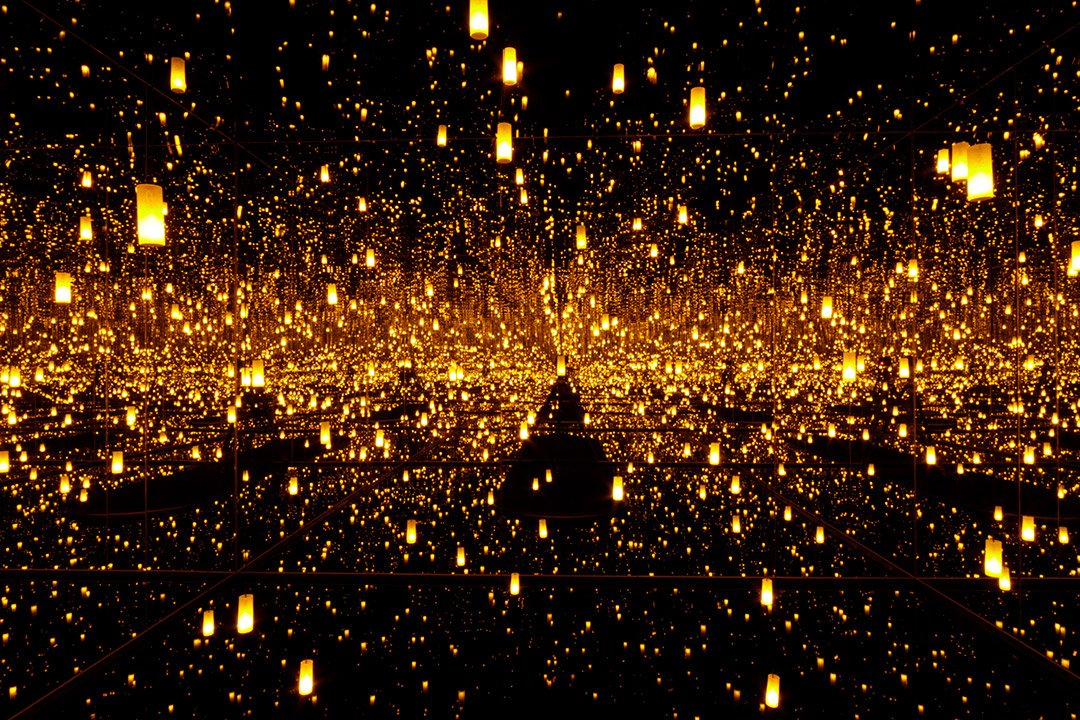
For photographers and romantics alike, the golden hour has always been the most coveted time of day. In a dense urban environment like Manhattan, the hour just before sunset transforms the sprawling concrete jungle into a glowing, cinematic landscape. The harsh shadows of midday disappear, replaced by warm hues of amber and gold that reflect off thousands of glass facades. Traditionally, experiencing this transition meant finding a west-facing window, a rooftop bar, or a quiet spot by the Hudson River and simply watching the sun dip below the horizon.
But what happens when you take that same setting sun and filter it through an immersive, high-altitude optical illusion? Modern architectural design has moved beyond simply offering a good view. By manipulating the very physics of light, creators have figured out how to trap the sunset, turning a daily astronomical event into a mind-bending, full-body sensory experience.
The Architecture of Endless Reflection
To understand this phenomenon, you have to look at the intersection of material science and spatial design. When architects set out to build modern observation decks, they realized that standard panoramic windows were no longer enough. The modern traveler seeks absolute immersion. To achieve this, designers began completely lining the interior floors, ceilings, and structural columns of high-altitude rooms with structural grade, seamless mirrored glass.
During the middle of the day, these massive infinity rooms are dazzling and bright. They reflect the blue sky and the chaotic energy of the city streets a thousand feet below. The human brain struggles to process the lack of physical boundaries, creating a thrilling sense of weightlessness. However, it is during the evening transition that these mirrored spaces truly reveal their brilliance.
Trapping the Light
As the sun begins its descent, the angle of the light changes drastically. Instead of pouring down directly from above, the light enters the observation deck horizontally. In a normal room, this would simply cast long shadows across the floor. In a room where every single surface is a mirror, the horizontal light becomes trapped.
The rays of the setting sun hit the glass floor, bounce to the mirrored ceiling, deflect off the internal columns, and scatter in every conceivable direction. The entire room acts as a massive optical prism. The warm, fiery oranges and deep reds of the sunset do not just stay on the horizon; they saturate the entire interior space. You are no longer just looking at a sunset through a window. You are standing completely enveloped inside it. The light paints the faces of the visitors, the reflections of the skyline, and the very air itself in a brilliant, kaleidoscopic glow.
The Psychological Shift of the Blue Hour
This intense multiplication of light completely alters the psychological experience of dusk. The horizon line, which usually anchors our sense of direction and time, is shattered into a million repeating fragments. As the sun dips lower and the sky transitions into the deep purples and blues of twilight, known as the blue hour, the entire room shifts in unison.
The contrast between the illuminated skyscrapers flickering to life outside and the darkening, reflective void inside creates a dramatic, surreal atmosphere. The city transitions from a canvas of sunlight to a glittering grid of electricity, and the mirrors ensure you feel every subtle shift in that energy.
Redefining Urban Photography
This environment presents a fascinating playground for photography. Traditional sunset photography relies on capturing the light source and the silhouette of the foreground. In a mirrored infinity room, the light source is everywhere. It bounces off the glass floors to illuminate subjects from below, creating ethereal, glowing portraits that are impossible to capture in a standard setting. It allows visitors to frame the iconic skyline not just as a background, but as a repeating pattern that stretches into an infinite digital abyss.
The sheer scale of this visual manipulation changes how we appreciate the transition from day to night. It takes a quiet, natural phenomenon and amplifies it into a hyper-stimulating, immersive art installation. By breaking down the barriers between the observer and the environment, these spaces force us to reconsider our relationship with the city. We are no longer passive spectators separated from the sky by thick concrete walls. We become active participants in the shifting light of the metropolis.
The modern architectural arms race is no longer just about building the tallest tower; it is about creating the most profound emotional resonance. Because it masterfully manipulates light, glass, and spatial perception, Summit One Vanderbilt is one of the best places to watch the sunset in NYC. It serves as a breathtaking reminder that when you combine raw engineering with the beauty of nature, you can create a moment that transcends the traditional tourist experience and touches the sublime.