Introduction
There are increasing challenges faced by the medical devices industry due to the escalating cost structure and high precision demands. Conventional manufacturing techniques such as CNC machining can lead to high costs associated with production, longer manufacturing cycles, and difficulty in ensuring consistency in the quality of manufactured components. The primary challenge with this conventional manufacturing process is its inability to cater to the needs of batch production of medical components which are increasingly becoming small and complex in nature.
This article delves into how Metal Injection Molding (MIM) technology provides a revolutionary solution through “one-shot” consolidation. It will detail the process advantages, cost benefits, and practical applications. The conclusion will reference JS Precision as a case study, highlighting its expertise in this advanced field. Let’s explore the key advantages of this transformative manufacturing technology.
What is the Metal Injection Molding Process, and How is it Reshaping Precision Manufacturing?
The metal injection molding process is a revolutionary manufacturing technique that combines the advantages of plastic injection molding and the material characteristics of metallic powders. It makes possible the mass production of miniature and complex metal components that would otherwise be challenging to produce through conventional means.
The Four-Step Core Process
This is a systematic sequence involving four critical stages:
- Feedstock Preparation and Injection Molding
Extremely fine metal powder is uniformly mixed with a specialized binder to create a viscous, moldable “feed stock.” This feed stock is then injected into a precision mold to form a “green” part.
- Debinding and Sintering
The “green” piece is processed using catalytic or solvent debinding to remove most of the binder and produce a porous “brown” piece. It is finally sintered in a furnace that operates at high temperature and in a controlled manner. The metal injection molding technology makes the part nearly fully dense and gives it all its mechanical properties.
The Secret of “Near-Net-Shape” Technology
The final aim of MIM technology is the manufacture of “near-net-shape” pieces. This means that after the sintering process, the piece has already attained its final shape. This cuts down, and in some cases eliminates the need for further machining. This technology is especially useful when dealing with complex and small pieces that cannot be machined, such as those with intricate cavities and surfaces.. For a complete breakdown, a detailed full process guide to metal injection molding technology explores materials and applications in depth.
What Specific Value Can Metal Injection Molding Services Bring to Medical and Aerospace Industries?
In industries such as medical and aerospace, where dependability, performance, and adherence to standards are of utmost importance, metal injection molding services help you take the benefits of your investments in parts well beyond their initial production. They provide a comprehensive plastics selection guide for injection molding for complicated problems. In the medical devices market, consolidation and biocompatibility are where the main advantages lie. MIM offers a range of benefits that eliminate the need for a number of operations while simultaneously improving quality and reliability of the devices: joint mechanisms for surgical instruments, multi-part assemblies for staplers, or complex structures for orthopedic devices can be designed and manufactured as single units by utilizing MIM technology.
Top-notch metal injection molding companies not only take advantage of qualitative material such as 316L stainless steel and titanium alloys, but also carry out very precise and high standard processing under ISO 13485 to ensure that the final products have good properties of biocompatibility and corrosion resistance to meet the regulators. When it comes to aerospace, the main values are lightness and strength. For aircraft engines and equipment inside the aircraft, there are many small and complex parts where the weight matters a lot, including structural parts and fasteners. MIM allows the production of these parts almost to their final shape, which are made of high-strength and high-temperature resistant alloys that are very difficult to machine .
Moreover, component consolidation is a great way to reduce the number of fasteners, which not only leads to the achievement of weight-saving targets but also guarantees the structural integrity and performance of the parts under very harsh conditions. MIM services are the way to go as they not only help enhance performances of the products but also reduce the overall costs for these industries which are very demanding.
What Key Certifications and Quality Standards Should You Focus on When Selecting Metal Injection Molding Suppliers?
Choosing a reliable metal injection molding suppliers is critical to project success. It relates not only to product quality but also to supply chain stability and market access. The primary differentiator is a robust quality system and relevant certifications.
Foundational Standards and In-Process Control
Selecting a capable metal injection molding suppliers requires evaluating both their certified quality systems and their operational discipline.
- Essential Quality Certifications
International certifications like ISO 9001, IATF 16949 (automotive), and ISO 13485 (medical devices) are critical. They prove a supplier, such as JS Precision, has a systematic, audited framework ensuring consistency and traceability for regulated industries.
- End-to-End Process Scrutiny
Apart from certification, the supplier must prove proficiency in controlling the whole process accurately. This includes performing strict tests on raw materials, proper monitoring of the molding, debinding, and sintering processes, and testing the completed parts in terms of their dimensions and mechanical properties.
Technical Collaboration
The best supplier should be your technical partner. They are well-informed about material science and process engineering. As such, they can contribute with very important input in terms of DFM. This will guarantee that your project is successful at all stages from prototyping to production.
What are the Fundamental Differences Between Metal Injection Mold and Traditional Plastic Mold Design?
Metal injection mold design presents unique challenges distinct from plastic molding, primarily due to substantial and predictable sintering shrinkage. While plastic shrinks minimally (<2%), MIM parts undergo 15-20% isotropic shrinkage during densification (e.g., ~17% for stainless steel). The mold cavity must be precisely scaled to compensate, demanding expert prediction of material behavior. In addition, the design needs to incorporate the rheological properties of feedstock with high powder loading during gating, proper venting to avoid burning, and delicate ejection mechanisms to accommodate brittle green bodies. An effective mold is therefore a blend of materials science and engineering principles, indispensable for crafting high-density parts.
How Significant is the Cost Advantage of Metal Injection Molding in Volume Production?
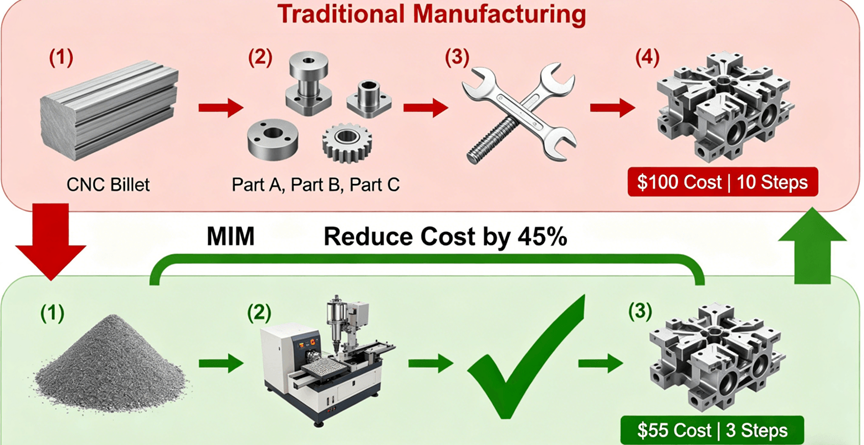
The economics of metal injection molding become compelling in high-volume production, which is a key value proposition offered by leading metal injection molding companies. The cost advantage is not merely a reduction in a single line item but a leveraged, overall cost reduction through process re-engineering.
Comparative cost calculation makes this quite evident. Take, for example, an intricate piece, which needs to go through several machining processes, such as conventional CNC, where you will have to buy raw materials, set up machines (milling, drilling, tapping), among others.Each step incurs machine time, tooling wear, fixture cost, and QC. Metal injection molding services consolidate this into: one molding step, debinding/sintering, and minor finishing. This drastic simplification cuts direct labor, machine occupancy, and energy consumption.
Specifically, MIM costs consist of: initial tooling cost, metal powder material cost, and amortized process energy costs. While the single upfront tooling cost may be higher than a machining fixture, the per-part cost plummets with volume. Data shows that MIM’s cost advantage becomes significant when a part requires five or more traditional machining operations. At production volumes of hundreds of thousands of units annually, MIM can reduce unit cost by 30% to 50% or more. For example, a medical sensor housing originally made from 5 assembled parts at a cost of 2.60perunitwasredesignedasasingleMIMpart,reducingthecostto1.30—a over 50% saving—while also improving seal integrity and strength. Therefore, for high-volume, design-stable, geometrically complex small metal parts, MIM is the high-value, volume manufacturing solution.
Conclusion
Metal Injection Molding represents a truly innovative process for fabricating high-precision metal parts, especially in fields such as medicine and aviation, where precision, performance, and reliability are essential characteristics. Team up with JS Precision, a partner that comes equipped with all the required international certification, in order to leverage your technological edge to competitive advantage.
For any assistance that is needed regarding the production of difficult precision metal components, please contact our engineering department for a complimentary DFM review and a quotation.
Author Bio
The author is an expert in the field of precision manufacturing with over 15 years of experience. He is well versed in the technical aspects and commercialization of the latest advanced manufacturing technologies. The author has been extensively involved in designing manufacturing solutions for a number of top-tier medical devices and aerospace applications, gaining extensive knowledge and experience in Metal Injection Molding Technology.
FAQs
Q1: What is an appropriate size of part that can be molded by metal injection molding?
A: Metal injection molding can mold metal parts up to a weight capacity of below 100 grams, but their largest dimension should not exceed 150 mm, which makes this process ideal for the manufacture of compact precision parts.
Q2: What tolerances can metal injection molding parts maintain?
A: The tolerance range that MIM parts can achieve is usually ±0.3% to ±0.5%. Tolerances of ±0.1% may even be reached in certain cases when dealing with straight dimensions. Moreover, the critical dimensions of these parts can even be further calibrated via secondary machining operations.
Q3: How much quantity is needed to make MIM economically viable?
A: Since tooling is a necessary expense before producing anything, it would make sense to use economical quantities such as 5,000 or more parts per annum. Of course, small-scale production (500-1,000 parts per year) is available with some MIM service providers.
Q4: How do mechanical properties of MIM components compare?
A: The mechanical properties of sintered MIM components are similar to those of wrought/machined parts made from the same materials with density above 98% of theoretical. The components also have heat treatability options and other finishes such as plating, passivation, or bead blasting depending on application requirements.
Q5: What is the production time frame for metal injection molding?
A: Time frame includes stages such as mold design/manufacture that take 4-8 weeks, first article sampling (T1) stage takes 2-3 weeks while volume manufacturing lead time varies based on quantity ordered. Time frame could be shorter for standard items.