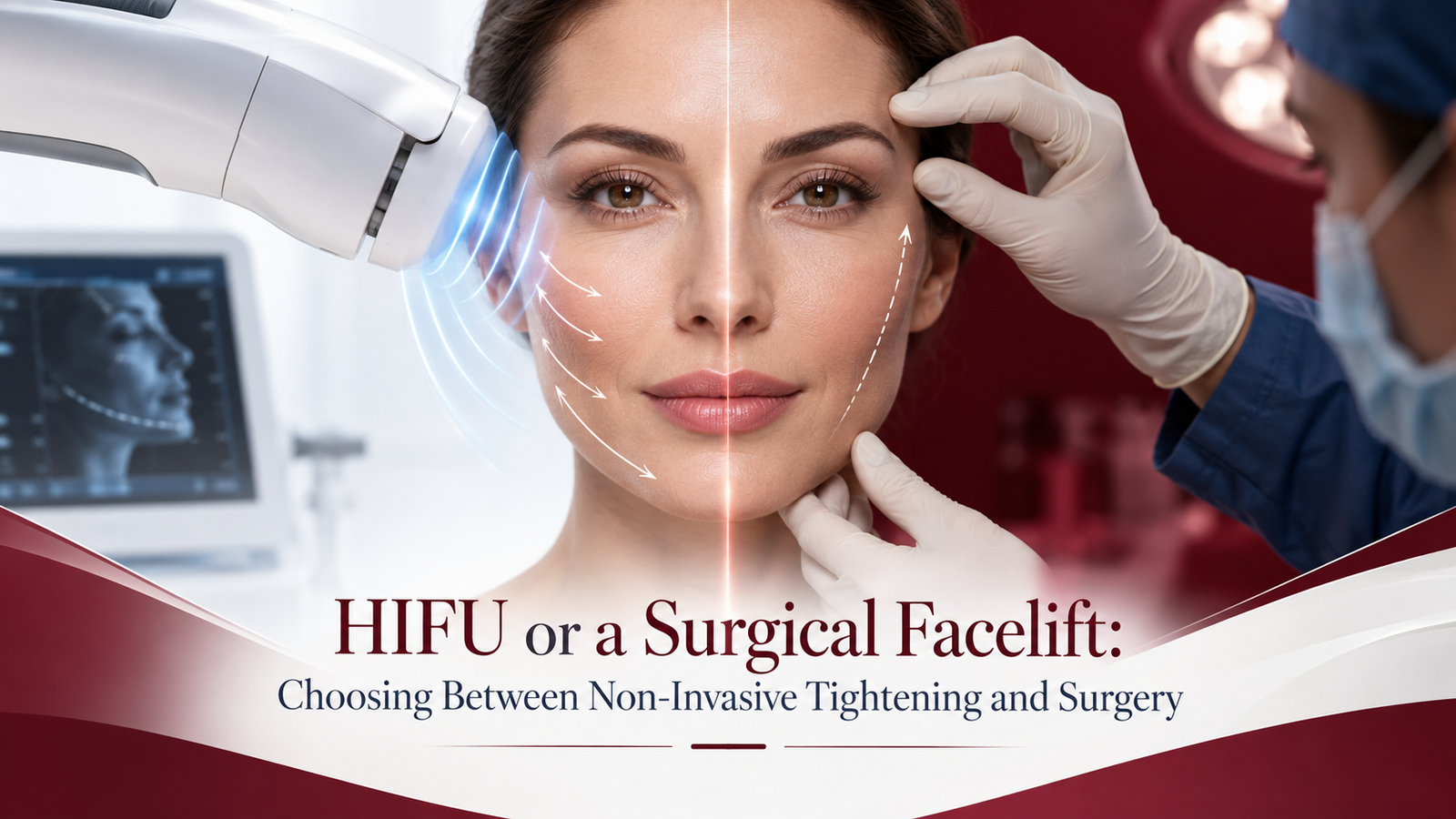
The clearest way to decide between HIFU and a facelift is to understand what each one physically does. HIFU (high-intensity focused ultrasound) tightens the face without cutting the skin: it heats small points deep in the tissue so the body responds by building new collagen. A surgical facelift does something a device cannot, it lifts and repositions the deeper support layer and trims away genuinely excess skin. That single difference, stimulating tissue versus removing and moving it, drives almost every other trade-off in cost, downtime, candidacy and how long the result holds.
The growing market of HIFU skin tightening devices has made non-surgical firming easy to try, and for the right person it delivers a real, if subtler, improvement. But easier is not the same as equivalent. Knowing which category you fall into matters more than any brand claim, so it helps to look at how each approach works before weighing the choice.
How HIFU firms the skin
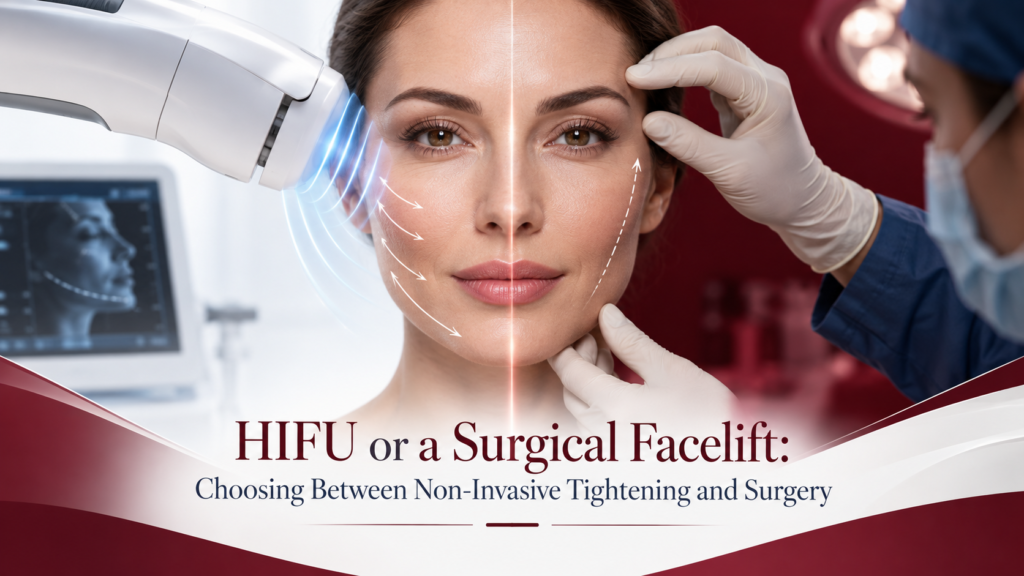
HIFU focuses ultrasound energy to a precise point below the surface, the way a magnifying glass concentrates sunlight. The surrounding skin stays untouched while heat is delivered to set depths, often in the range of about 1.5 to 4.5 millimeters, reaching the deep dermis and the superficial musculoaponeurotic system, the fibrous support layer surgeons also target. The controlled heat creates tiny zones of thermal injury that trigger new collagen formation over the following weeks.
Because the effect depends on your body remodeling collagen, results appear gradually rather than the day of treatment. Most people see firming build over roughly two to three months. Micro-focused ultrasound has regulatory clearance in the United States for lifting the skin of the brow, under the chin and on the neck, and for improving lines on the chest. The trade-off is scale: HIFU refreshes and tightens mild to moderate laxity, but it does not remove loose skin, so it cannot reproduce the change a facelift makes on heavier sagging.
What a surgical facelift does differently
A facelift, or rhytidectomy, is an operation performed under sedation or general anesthesia. The surgeon lifts the skin, tightens and repositions the underlying muscle and connective tissue, then removes the excess skin and redrapes what remains. This is why professional bodies note that minimally invasive treatments cannot match a facelift; only surgery can physically eliminate surplus skin and reset deep structures. A facelift also does not stop the clock or change your fundamental features, it turns the face back and then aging resumes from that new point.
HIFU and facelift compared
| Factor | HIFU | Surgical facelift |
| Method | Focused heat stimulates new collagen, no incisions | Skin lifted, deep layer tightened, excess skin removed |
| Best for | Mild to moderate laxity, early sagging | Pronounced jowls, deep folds, loose neck skin |
| Anesthesia | None, topical comfort measures at most | Sedation or general anesthesia |
| Downtime | Little to none, back to routine same day | Weeks, with bandaging, swelling and bruising |
| Results appear | Gradually over two to three months | Visible once swelling settles, refining over months |
| Longevity | About a year, extended with maintenance sessions | Commonly a decade or more, aging still continues |
| Main drawbacks | Limited lift, not for heavy sagging | Surgical risks, cost, recovery time |
Which one fits your situation
The honest deciding factor is how much loose skin you have. If your concern is early softening of the jawline, a little crepiness or skin that looks tired rather than fallen, HIFU is a reasonable match and avoids surgery entirely. It also suits people who want to delay a facelift, or who cannot take downtime. Plastic surgeons increasingly treat energy-based tightening as something that can postpone the moment surgery becomes appropriate and complement it later.
A facelift becomes the more logical choice when the skin has clearly descended: heavy jowls, deep nasolabial folds, banding or hanging skin on the neck. No amount of collagen stimulation lifts tissue that has physically dropped and stretched. Good surgical candidates are generally healthy, do not smoke and hold realistic expectations. Smoking, uncontrolled high blood pressure and diabetes raise the risk of poor healing and are important to disclose.
Downtime, risks and recovery
This is where the two paths separate most sharply. HIFU carries little downtime; temporary redness, mild swelling, tingling or tenderness and occasional short-lived numbness are the usual complaints, and most people return to normal activity right away. A facelift is real surgery with real recovery. Expect bandaging, sometimes small drains, and swelling and bruising that take weeks to settle before you look presentable in public.
The risk profiles differ in kind, not just degree. The most common facelift complication is a hematoma, a collection of blood under the skin that may need a return to the operating room. Less often, surgery can injure facial nerves, with the great auricular nerve the sensory nerve most frequently affected, or cause skin-flap healing problems, infection or a reaction to anesthesia. HIFU avoids these surgical risks, and its rare problems are usually temporary. Any energy or surgical treatment on the face should be performed by a qualified, experienced practitioner, and a personal assessment is the only way to judge suitability.
How long the results really last
Neither option is permanent, because the face keeps aging. HIFU results typically hold for around a year and can be topped up with repeat sessions, which makes it a maintenance approach rather than a one-time fix. A facelift lasts far longer, commonly a decade or more depending on technique and individual factors, but it too is a reset rather than a freeze. Framing the decision as maintenance versus reset, rather than cheap versus expensive, usually leads to a choice you will be happier with.
Common questions
Can HIFU replace a facelift?
Not for significant sagging. HIFU firms and refreshes mild to moderate laxity, but it cannot remove excess skin or reposition deep tissue the way surgery does. For advanced aging, it is a complement or a delaying tactic, not a substitute.
Can the two be combined?
Yes. Many people use energy-based tightening to maintain skin quality before surgery becomes necessary, and again after a facelift to help extend and support the result. A clinician can sequence them to your needs.
Does HIFU hurt?
Sensations vary from warmth to brief prickling or deeper tingling as energy is delivered, and comfort settings and topical measures help. It is far removed from surgical recovery, though tenderness can linger for a short time.